Dietary Compliance Audits in Nursing Homes: A Practical Guide

Dietary Compliance Audits in Nursing Homes: A Practical Guide
A dietary compliance audit in a nursing home is a structured check that every resident gets the diet they are ordered, in the right form, at a safe temperature, with the paperwork to prove it. The standard is 42 CFR 483.60. The best audits compare three things: what the record says, what the kitchen prepared, and what actually reached the resident’s table.
This guide is for administrators, dietary managers and quality leads who want an audit routine that holds up on survey day and keeps working between surveys.
TL;DR
- Dietary compliance means each resident gets a nourishing, palatable, well-balanced diet that meets daily nutritional and special dietary needs, with preferences considered.
- A strong audit triangulates three sources: assessment data, the care plan and physician orders, and direct observation at meals.
- Check the kitchen too: refrigerator and freezer temperatures, hot and cold holding on the tray line, sanitation and training records.
- When you find a gap, fix the cause, re-train, then run repeat audits and report results to your QAPI committee.
- Keep audit evidence in one place so it can be exported for a surveyor without a scramble.
Table of Contents
- What dietary compliance means in a nursing home
- What a dietary audit should review
- How to run the audit, step by step
- What to do when the audit finds a problem
- Sustaining compliance after the fix
- Our perspective
- Put your audit on a phone
- FAQ
- Sources
What dietary compliance means in a nursing home
In a skilled nursing facility or nursing facility, dietary compliance is not a kitchen-only topic. Under the federal food and nutrition services rule, residents must receive a nourishing, palatable, well-balanced diet that meets their daily nutritional and special dietary needs, taking preferences into consideration. That one sentence covers menus, therapeutic diets, texture and liquid consistency, allergies, assistance at meals and the way staff document all of it.

The rule also sets expectations for menus. They must be prepared in advance, followed, updated periodically and reviewed by the facility’s dietitian or another clinically qualified nutrition professional for nutritional adequacy. Menus must reflect, based on reasonable efforts, the religious, cultural and ethnic needs of the resident population and input from residents and resident groups, and they must not limit a resident’s right to make personal dietary choices.
The nutrition requirement sits alongside it. Based on the comprehensive assessment, the facility must ensure the resident maintains acceptable parameters of nutritional status unless the clinical condition shows this is not possible, and that the resident receives a therapeutic diet when there is a nutritional problem.
Why it matters beyond the kitchen
SNFs and NFs must comply with 42 CFR Part 483, Subpart B to be paid under Medicare or Medicaid, and state surveyors complete at least Life Safety Code, Standard Health and Emergency Preparedness surveys to certify a facility. Dietary findings therefore sit inside the same survey that decides your standing. If you want a refresher on how citations are numbered and grouped, our guide to CMS F-tags for administrators is a good companion.
What a dietary audit should review
Survey tools give a useful blueprint, because they show what an outside reviewer will look at. Build your internal audit around the same elements. There are two halves: the resident side and the food service side.
The resident side: records against reality
CMS’s Nutrition Critical Element Pathway directs reviewers to the most current comprehensive assessment and the most recent quarterly MDS and CAAs, the care plan, physician’s orders, and pertinent diagnoses, allergies, intolerances and preferences. It also asks whether:
- nutritional needs were assessed;
- the cause of weight loss was identified when applicable;
- interventions and the care plan were revised when nutritional status changed;
- meal intakes, supplements and weights are documented.
A useful rule: every item on that list should be answerable from a record in under a minute. If it takes a search through three binders, the audit has already found a problem.
The meal itself: what the observer sees
The same pathway has observers watch the resident at a meal. Is the ordered diet followed? Are portions appropriate? Are assistance and cues given, and are assistive devices used correctly? Does staff respond when the resident is not eating or refuses?
The Ohio Department of Health’s Nutrition Survey Readiness Guide (dated July 30, 2024) adds practical meal observables. They include:
- physician orders covering allergies, intolerances, preferences and assistance;
- correct portion sizes and substitutions;
- assistive devices for eating;
- enough time to eat;
- call lights within reach;
- meal refusals and the interventions tried;
- documentation of intakes, supplements and weights.
The same guide notes a meal-span expectation aligned with federal standards: no more than 14 hours between the evening and morning meals, or up to 16 hours when a substantial evening snack is offered. It also directs facilities to make sure alternative meals and snacks are available. Time between meals is an easy thing to audit and an easy thing to miss.
The kitchen side: temperatures and sanitation
CMS’s Kitchen/Food Service Observation form (CMS-804) sets concrete numbers an auditor can check with a thermometer:
| Check | What the form looks for |
|---|---|
| Refrigerator temperature | 41°F or below (the form notes a 2 to 3 degree variance) |
| Freezer | Foods frozen solid |
| Refrigerator and freezer surfaces | Shelves and floors clean and free of spillage |
| Hot food on the tray line | 135°F or above |
| Cold food on the tray line | 41°F or below |
Safe storage, temperature control, sanitation and dishwashing all belong in your kitchen walk-through. For a plain-language look at the same habits in a home setting, these kitchen safety practices for seniors show how small routines prevent big problems. If cold storage is your weak spot, our refrigerator cleaning schedule turns the cleanliness item into a recurring task.
State rules add detail
Federal rules set the floor, and states add specifics. Illinois, for example, requires under 77 Ill. Admin. Code §330.1940 that:
- a current diet manual is available and in use;
- physicians write a diet order that states a general or therapeutic diet, with delegation to a dietitian allowed;
- the diet order is in the medical record and served as ordered;
- diet changes are ordered by the physician or dietitian;
- the resident is observed for acceptance of the diet and the observations are recorded.
The same section sets review intervals: oral liquid diets every 48 hours, and other therapeutic or mechanically altered diets as needed or at least every three months. Check your own state’s code and health department guidance, because your audit calendar should match the strictest rule that applies to you.
How to run the audit, step by step
The pathway’s logic is process control: compare the assessment, the orders and the care plan, then compare all of that against what you observe. Here is a routine that follows it.
- Pick a sample. Include residents on therapeutic diets, texture-modified diets or thickened liquids, residents with recent weight changes, and residents who need eating assistance.
- Review the record first. Read the latest assessment, care plan, physician order, allergies, intolerances and preferences. Write down what the tray should contain before you see it.
- Observe the meal. Check the diet against the order, the portion, the consistency, the assistive devices, the cueing and the time the resident has to eat. Watch more than one shift where appropriate.
- Walk the kitchen. Log refrigerator, freezer and tray-line temperatures and note sanitation conditions.
- Compare and score. Mark each item as met or not met, and note the exact reason.
- Confirm the paperwork. Look for documented intakes, supplements and weights, and for evidence that interventions were revised when status changed.
- Assign owners and dates for every gap before you leave the room.
The ANFP’s survey readiness tips list what to keep on hand: food safety and sanitation training documentation, weekly menus and extensions, a list of residents’ diets (including mechanically altered diets and adaptive equipment), a list of residents receiving special snacks, and temperature logs. Treat that as your evidence binder, whether it lives on paper or on a phone.
Texture and consistency errors deserve extra attention. Our texture modified diets guide covers staff handling, and the calorie count sheet checklist shows what good intake documentation looks like.
What to do when the audit finds a problem
Start with the cause, not the person. CMS’s guidance on nutrition says a facility’s response to a decline is avoidable when staff did not assess nutritional status and risk factors, define and implement interventions that fit resident needs and goals, monitor and evaluate their impact, or revise them when appropriate. Those four steps are a good frame for any corrective action: assess, intervene, monitor, revise.
Public plans of correction show how real facilities respond:
- After a resident was served thin soup instead of puree, a New Jersey facility’s immediate actions included in-servicing staff on checking tray accuracy, serving the diet according to the physician’s order, and using thickening powder according to packet directions.
- In a South Dakota complaint survey about hot beverages, the facility reported contacting the dietitian for acceptable temperatures, asking the vendor to lower the dispenser temperature, unplugging dispensers until the vendor arrived, and writing new policies with education on temperatures and monitoring of assisted dining. The survey document shows substantial compliance the next day.
Notice the pattern: stop the immediate risk, fix the process, teach the staff, then verify.
Sustaining compliance after the fix
One good audit proves little. Repeat audits show the fix is holding. A New Jersey plan of correction for a therapeutic diet citation describes a schedule many quality teams copy: daily random audits during meal service for two weeks, then weekly for three months, to confirm residents receive the proper liquid consistency, with results submitted monthly for four months to the QAPI committee.
A practical version of that schedule:
- Weeks 1 to 2: daily spot checks at meal service, focused on the cited issue.
- Months 1 to 3: weekly checks, with the same form every time so results compare.
- Months 1 to 4: monthly summary to QAPI, with trends and any new actions.
- After that: fold the check into your regular rounds so it stays routine.
For the bigger picture of tracking recurring requirements, see our guide to compliance tracking in healthcare. If your audit also touches menu design, cafeteria menu planning covers the planning side. Reading other facilities’ citations also teaches a lot, and where to find nursing home state survey reports shows how.
Our perspective
Most dietary citations we read are not about people who do not care. They are about a good check that lived on a clipboard, got done on a busy shift, or never got repeated. The work is real. The system around it is what slips.
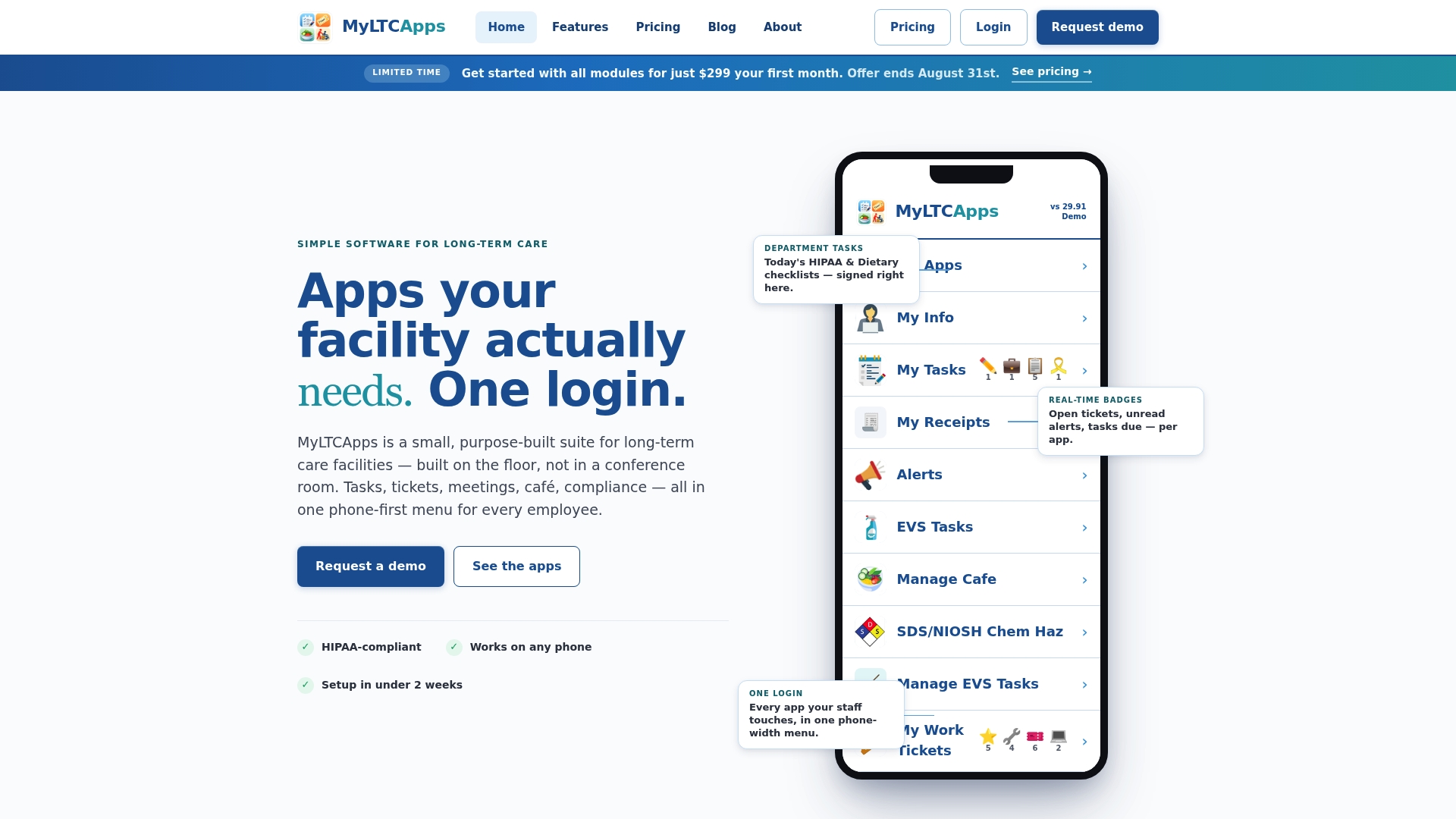
We built MyLTCApps around that. Care staff work from their phones, so a checklist should take a few taps on one thumb, not a trip to the office. When the audit form, the temperature log and the follow-up task sit in the same phone-first menu, the check gets done where the work happens.
Our approach to compliance is to seed the libraries, including dietary and QAPI, so your team starts from a structure instead of a blank page. Then export surveyor-ready reports from the same records you use every day. That is how we think audit evidence should work: collected as a by-product of daily work, not assembled the week before a survey.
Philip
Put your audit on a phone
MyLTCApps is a phone-first suite for long-term care and skilled nursing facilities. It includes mobile checklists, real-time staff tasks, alerts, a compliance suite with seeded libraries (HIPAA, Section 1557, dietary, QAPI and emergency preparedness), resident meal tracking and surveyor-ready reporting exports. It does not replace clinical charting, and it is not meant to.
Plans are priced per facility per month: I Just Want That at $199, Starter Pack at $299, Growth Pack at $499 and Premium Pack at $792, as published on our pricing page. You can see how the Compliance Suite handles dietary and QAPI tracking, or how daily checklists and tasks put temperature logs and meal-service checks in your staff’s hands. If you run a staff dining program, our cafeteria and dining management tools are also available.
FAQ
What does dietary compliance mean in a nursing home?
It means residents receive a nourishing, palatable, well-balanced diet that meets their daily and special dietary needs, with their preferences considered, as required by 42 CFR 483.60. Menus must be planned in advance, followed and reviewed by a dietitian or other qualified nutrition professional. Records must show that diet orders were carried out.
How often should we audit dietary compliance?
Federal rules do not set one universal audit frequency, so set yours by risk. Many facilities run routine weekly meal observations and use a tighter schedule after a finding, such as the daily-then-weekly pattern in the New Jersey plan of correction above. Check your state’s rules for any required review intervals for diets.
Who should perform the audit?
A dietary manager, a dietitian, a nurse leader or a trained QAPI team member can all do it. What matters is that the auditor can compare the record to the meal in front of them and has no stake in the result looking good. Rotating auditors also helps spot blind spots.
What records should be ready for a surveyor?
Keep current menus, a list of resident diets including mechanically altered diets and adaptive equipment, a list of residents on special snacks, temperature logs and food safety training documentation, as the ANFP lists. Add care plans, orders, and documented intakes, supplements and weights for the residents in your sample.
Sources
- 42 CFR 483.60, Food and nutrition services (eCFR)
- CMS F325 Nutrition guidance (§483.25(i))
- CMS Nursing Homes certification overview
- CMS Nutrition Critical Element Pathway
- CMS Form 804, Kitchen/Food Service Observation
- Ohio Department of Health Nutrition Survey Readiness Guide
- 77 Ill. Admin. Code §330.1940, Diet Orders
- ANFP Top 10 Tips to Ensure Your Facility is Survey-Ready
- New Jersey survey document, thickened liquid plan of correction
- South Dakota complaint survey, hot beverage plan of correction
- New Jersey survey document, therapeutic diet audit schedule
- Kitchen Safety for Seniors: Practical Tips for Caregivers