CMS F-Tags Explained for Nursing Home Administrators

CMS F-Tags Explained for Nursing Home Administrators
CMS F-tags are the federal identifiers surveyors use to document regulatory deficiencies in long-term care facilities under 42 CFR Part 483. Each tag maps to a specific provision in the Requirements for Participation, and when a surveyor cites one on Form CMS-2567 (the Statement of Deficiencies), your facility has a documented compliance failure that affects your Five-Star rating, your Medicare/Medicaid participation status, and potentially your reimbursement. The authoritative source for the current tag list is CMS’s List of Revised F-Tags PDF, which includes a crosswalk mapping legacy numbers to the revised tags effective April 28, 2025. Appendix PP of the State Operations Manual is the surveyor guidance document that defines exactly how each tag is evaluated.
Three things to do right now:
- Download the revised list and crosswalk from CMS’s Nursing Homes guidance hub and compare your facility’s historical citations against the new numbering.
- Audit your top-risk areas first. 2025 deficiency data shows F880 (infection prevention and control), F689 (accident hazards and supervision), and F812 (food procurement, storage, and service) as the most frequently cited tags across recertification surveys.
- Schedule a focused mock survey targeting those three areas before your next standard survey window.
Key Takeaways
CMS F-tags are the numbered deficiency identifiers tied to 42 CFR Part 483 that surveyors use to document compliance failures — and the April 28, 2025 revised list, available from CMS with a full crosswalk, is the document every administrator must have on hand.
| Point | Details |
|---|---|
| Download the revised list now | The CMS List of Revised F-Tags PDF (effective April 28, 2025) includes a crosswalk for mapping legacy citations to current tags. |
| Prioritize the top three tags | F880 (infection control), F689 (accident hazards), and F812 (food safety) are the most frequently cited tags in 2025 surveys. |
| PoC window is 10 days | Submit your Plan of Correction within 10 calendar days of receiving Form CMS-2567; late submission compounds your exposure. |
| Use the crosswalk for trending | Map historical citations to current tag numbers in your QAPI log to identify repeat patterns and support IDR evidence. |
| Myltcapps operationalizes daily compliance | Mobile checklists, incident reporting, competency tracking, and survey-ready exports reduce documentation gaps before a surveyor arrives. |
This article is general information, not a substitute for advice from a qualified doctor. Consult a qualified healthcare professional about your own circumstances before acting on anything here.
Table of Contents
- What are CMS F-tags and why do they matter for certification?
- What changed in the 2025 revised F-tag list?
- Which F-tags do facilities get cited for most often?
- How do surveyors apply F-tags during a survey?
- How to prepare your facility and reduce F-tag risk
- What to do immediately after receiving an F-tag citation
- Where to find the official CMS documents and resources
- How Myltcapps helps operationalize F-tag compliance
- The part most administrators underestimate
- Myltcapps: built for the compliance work that happens every day
- Sources
What are CMS F-tags and why do they matter for certification?
An F-tag is a numbered identifier assigned to a specific regulatory requirement under 42 CFR Part 483. When a state surveyor observes a deficiency during a standard, complaint, or focused survey, they select the F-tag that corresponds to the violated provision and record it on Form CMS-2567. That form is the official record of what went wrong, at what scope and severity, and what your facility must correct.
The interpretive backbone is Appendix PP of the State Operations Manual. Appendix PP is not the regulation itself — it is CMS’s guidance to surveyors on how to evaluate compliance. Each F-tag entry in Appendix PP contains four components:
- The verbatim regulatory text from 42 CFR Part 483
- The intent of the requirement (what CMS is trying to protect)
- Surveyor instructions (what to observe, ask, and review)
- Key elements surveyors must assess to determine compliance
Understanding that structure matters because your internal audits should mirror it. If your audit script does not test the same elements Appendix PP lists, you will miss what surveyors catch.
Practical consequences of a citation are significant. A deficiency triggers a mandatory Plan of Correction (PoC) with a 10-day submission window. Depending on scope and severity, CMS may impose civil monetary penalties, directed in-service training, temporary management, or denial of payment for new admissions. Every citation also feeds into the health inspection component of the Five-Star Quality Rating System, where more severe deficiencies carry greater weight and can significantly impact a facility’s rating.
What changed in the 2025 revised F-tag list?
CMS revised and renumbered a substantial portion of the F-tag list to align with updates to the Requirements for Participation and Appendix PP. The revised LTC surveyor guidance accompanying these changes, including QSO memos such as QSO-25-14-NH, clarifies how surveyors evaluate compliance under the updated framework. The effective date for the revised list is April 28, 2025.
Key structural changes include:
- Transfer and discharge consolidation. Multiple legacy tags covering transfer and discharge rights were merged into F627 and F628, reducing redundancy but requiring facilities to map older citations carefully.
- Psychotropic and chemical restraint reorganization. Guidance on antipsychotic use and chemical restraints was restructured, with clearer surveyor instructions on documentation thresholds.
- Infection control expansion. Tags in the F880-series were updated to reflect current CDC and CMS infection prevention standards, including NHSN reporting expectations.
The crosswalk file included in the revised F-Tags PDF lists every old tag number alongside its new equivalent. To use it: pull your facility’s deficiency history from the last three years, match each legacy tag to the new number, and rebuild your trending data under the current numbering. That mapping is not just administrative housekeeping. If you file an Informal Dispute Resolution (IDR) on a current citation, surveyors and CMS reviewers will look at your deficiency history — and a clean crosswalk makes that history legible.
Pro Tip: Add a “crosswalk verified” column to your QAPI deficiency log. Each time you review a historical citation, note the legacy tag, the current equivalent, and whether the root cause was fully resolved. That single column turns a compliance archive into a live risk register.
Which F-tags do facilities get cited for most often?
2025 deficiency data shows a consistent cluster of high-frequency citations. These are not random — they reflect areas where surveyor observation is easiest and documentation gaps are most common.
- F880 — Infection Prevention and Control: The most frequently cited tag. Common triggers include missing or outdated IPC policies, gaps in hand hygiene observation, improper PPE use, and failure to maintain NHSN reporting. F880 is almost always cross-tagged with F884 (reporting) or F881 (antibiotic stewardship) when the root cause is systemic.
- F689 — Free from Accident Hazards and Supervision: Falls with injury are the primary driver. Surveyors look for whether the care plan identified the fall risk, whether interventions were in place, and whether staff followed them. A fall alone does not generate a citation; a fall with no documented risk assessment or inconsistent intervention does.
- F812 — Food Procurement, Storage, Preparation, and Service: Expired food in storage, improper temperature logs, and unlabeled items are the most common triggers. Surveyors walk the kitchen and storage areas on virtually every survey.
- F684 — Quality of Care: Broad tag covering wound care, pressure injury prevention, and clinical monitoring. Pressure ulcer development without documented prevention efforts is a frequent citation driver.
- F656 — Care Planning: Incomplete or outdated care plans, particularly after a change in condition, generate citations here. Surveyors cross-reference care plans against nursing notes and physician orders to find gaps.
Cross-tagging is a real operational risk. A single IPC failure — say, a nurse observed not performing hand hygiene before a wound dressing — can generate F880, F684, and F656 citations simultaneously if the care plan and documentation are also deficient. Fixing the isolated behavior without addressing the documentation and care-planning process leaves two of the three citations unresolved.
How do surveyors apply F-tags during a survey?
Surveyors follow a structured investigation process defined in Appendix PP. The LTC Survey FAQs PDF explains the practical mechanics, including how surveyors select and move citations on the Potential Citation screen. Here is the sequence:
- Observation. Surveyors observe care delivery, the physical environment, food service, medication administration, and staff practices in real time.
- Record review. They pull care plans, nursing notes, incident reports, physician orders, and audit logs to corroborate or contradict what they observed.
- Interviews. Residents, family members, and staff are interviewed to gather additional evidence. Resident interviews often surface issues that records do not show.
- Deficiency determination. The surveyor team compares findings against Appendix PP criteria and determines whether a deficiency exists.
- Citation selection. The team selects the F-tag that best fits the deficiency. When multiple tags apply, all relevant ones are cited.
- Statement of Deficiencies. Findings are documented on Form CMS-2567, which your facility receives at the close of the survey.
The scope and severity grid determines the weight of each citation. Scope runs from isolated to widespread; severity runs from no actual harm (potential for minimal harm) through actual harm to immediate jeopardy. Immediate jeopardy citations require same-day or next-day corrective action and carry the heaviest Five-Star penalties. A single immediate jeopardy finding can reduce a facility’s health inspection score to one star regardless of its prior rating.
When you receive the Statement of Deficiencies, your 10-day PoC clock starts. Do not wait for the full exit conference summary — begin your internal triage the same day.
How to prepare your facility and reduce F-tag risk
The short answer: audit what surveyors audit, using the same Appendix PP criteria they use. Facilities that mirror surveyor observation scripts in their internal rounds consistently find gaps before surveyors do.
- QAPI-focused deficiency audits. Review your last three survey cycles, map citations to current tags using the crosswalk, and build QAPI projects around repeat patterns. A tag cited twice in three years is a systemic issue, not bad luck.
- IPC program review. Verify that your IPC policies reflect current CDC guidance, that your NHSN reporting is current, and that hand hygiene and PPE compliance are being observed and documented — not just trained.
- Medication storage and labeling audit. Walk the medication room and all satellite storage areas. Check expiration dates, labeling, temperature logs, and controlled substance counts. This takes 30 minutes and routinely surfaces F-tag risk.
- Care plan completeness audit. Pull a random sample of 10 active residents and check whether care plans were updated after the last change in condition, hospitalization, or fall. Gaps here generate F656 and often F684.
- Food safety inspection. Walk the kitchen and storage areas with a temperature log and an eye for labeling. Check the cafeteria and dining management documentation for temperature records and procurement logs.
- Staff competency verification. Confirm that competency assessments are current for high-risk procedures: wound care, medication administration, fall prevention interventions, and IPC protocols. Outdated competency records are a direct citation trigger.
- Mock survey with documentation review. Run a mock survey using Appendix PP surveyor instructions as your script. Have someone unfamiliar with the unit conduct resident interviews. The surprises in a mock survey are far less costly than the ones in a real one.
Pro Tip: Download the survey resources ZIP from CMS. It contains the worksheets and appendices surveyors reference during the survey. Convert those worksheets into your internal audit scripts — you will be testing against the exact criteria surveyors use.
For near-miss reporting tied to falls and safety incidents, a documented near-miss program demonstrates proactive risk management and can support your PoC narrative when F689 is cited.

What to do immediately after receiving an F-tag citation
Speed and specificity matter. A vague PoC that says “staff will be re-educated” is the fastest way to get a deficient PoC determination, which extends your exposure and delays survey closure.
- Secure affected residents. If the citation involves a resident safety risk, address it before anything else. Document the immediate protective action with a time stamp.
- Collect evidence. Pull the records, care plans, incident reports, and audit logs relevant to the cited deficiency. Identify the specific residents involved and the date range of the deficiency.
- Identify the root cause. Was it a policy gap, a training failure, a documentation breakdown, or a supervision lapse? Your PoC must address the actual cause, not the symptom.
- Draft a measurable PoC. Structure it in three parts: what you did for the affected resident(s), what systemic change you made to prevent recurrence, and how you will monitor compliance going forward. Include specific dates, responsible parties, and measurable monitoring criteria.
- Submit within 10 days. The PoC must be submitted to the state survey agency within 10 calendar days of receiving the Statement of Deficiencies. Late submission is itself a compliance failure.
- Implement and document follow-up. Monitoring must be ongoing and documented. Surveyors at the revisit will ask for evidence that your monitoring actually happened — not just that you planned it.
On Informal Dispute Resolution: IDR is available when you believe a citation was factually incorrect or the scope and severity was overstated. File within 10 days of receiving the Statement of Deficiencies. Successful IDR disputes typically rest on documented evidence that the deficiency did not occur or that the surveyor’s observation was incomplete. The LTC Survey FAQs covers the procedural mechanics of IDR and formal appeals.
Where to find the official CMS documents and resources
Every resource below is available directly from CMS. Bookmark these — do not rely on third-party mirrors for compliance decisions.
- List of Revised F-Tags PDF: The canonical current tag list with the crosswalk. Download this first. Effective April 28, 2025.
- CMS Nursing Homes guidance hub: Central landing page for Appendix PP, QSO memos, the revised F-Tags PDF, and all LTC survey resources. Check this page after every QSO memo release.
- Appendix PP (State Operations Manual): The surveyor guidance document. Every F-tag entry includes regulatory text, intent, and step-by-step surveyor instructions. This is what surveyors carry into your building.
- LTC Survey FAQs PDF: Procedural Q&A covering citation mechanics, PoC requirements, and IDR processes. Useful for compliance officers preparing PoC responses.
- Revised LTC Surveyor Guidance / QSO memos: CMS transmittals (including QSO-25-14-NH) that explain changes to survey protocols and Appendix PP. Read these when a new memo is issued — they often signal where surveyor focus is shifting.
- Survey Resources ZIP: Downloadable package of appendices, worksheets, and tools referenced in Appendix PP. Convert these into internal audit instruments.
- 42 CFR Part 483 on eCFR: The codified regulatory text. When Appendix PP references a specific subpart, this is where you read the actual law.
For version control: note the effective date on every document you download. CMS updates Appendix PP and the tag list without always issuing a press release. The QSO memo page is the most reliable indicator of recent changes.
How Myltcapps helps operationalize F-tag compliance
Compliance software does not replace clinical judgment, but it closes the documentation gaps that generate citations. Myltcapps is built specifically for long-term care facilities, with a phone-first interface that puts compliance tasks directly in the hands of the staff doing the work.
Relevant features mapped to F-tag risk areas:
- Compliance task checklists seeded with IPC, QAPI, dietary, and HIPAA requirements — staff complete them on their phones, and administrators see real-time completion status from the admin dashboard.
- Incident reporting for falls, near-misses, and safety events, with time-stamped documentation that supports F689 PoC narratives.
- Cafeteria and dining management that tracks meal service, temperature logs, and resident dietary preferences — directly relevant to F812 food safety requirements.
- Nurse competency tracking to maintain current competency records for wound care, medication administration, and IPC protocols.
- Survey-ready reporting exports that compile audit logs, task completion records, and incident reports into formats surveyors can review on-site.
A facility using Myltcapps’s checklist automation and centralized evidence collection can reduce the time spent assembling PoC documentation from days to hours, because the audit trail is already built into daily operations rather than reconstructed after a citation.
The part most administrators underestimate
The facilities that consistently score well on surveys are not the ones that prepare harder in the 60 days before a survey. They are the ones that have made compliance work indistinguishable from daily operations. That sounds obvious, but the gap between knowing it and doing it is where most citations live.
If you can only move three things this quarter, make them these: shore up your IPC program with observed hand hygiene audits (not just training sign-offs), build a reliable fall-risk monitoring loop that closes the gap between assessment and care-plan update, and fix medication storage and labeling before the next kitchen walk. Those three areas account for the majority of citations in any given survey cycle, and they are all correctable with process discipline rather than capital investment.

Embed your audit results in QAPI and governance reports. A deficiency that appears in a QAPI project report signals to surveyors that your facility identified the problem and addressed it systematically. That context does not eliminate the citation, but it materially affects how surveyors interpret your facility’s culture of compliance.
Myltcapps: built for the compliance work that happens every day
Preparing for a survey should not feel like a sprint. Myltcapps gives long-term care administrators a daily compliance task and checklist platform that keeps IPC audits, food safety checks, incident reports, and competency records current without adding administrative burden to already stretched staff.
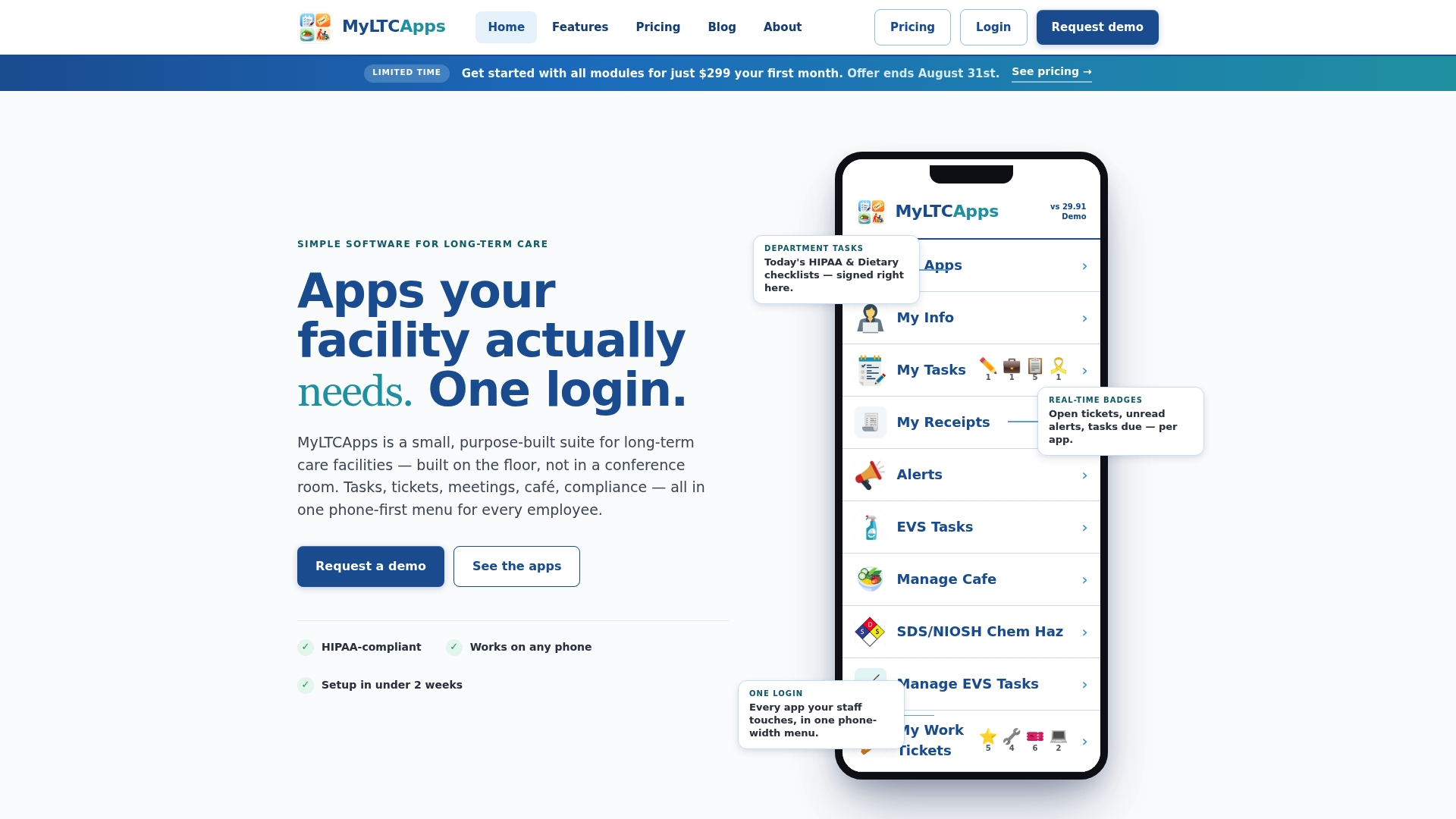
The platform’s seeded compliance libraries cover HIPAA, QAPI, dietary, and emergency preparedness requirements out of the box. Staff complete tasks on their personal phones; administrators see completion status, flag gaps, and pull survey-ready exports without hunting through paper logs. For facilities managing Kansas long-term care regulations or KDADS-ready compliance requirements, Myltcapps offers a Kansas-specific LTC software solution tailored to state survey expectations. Request a demo at Myltcapps and see how the platform maps to your top-cited F-tags.
Sources
- Cms
- Nursing Homes | CMS
- LTC Survey FAQs (CMS PDF)
- Federal Register :: Request Access
- REVISED: Revised Long-Term Care (LTC) Surveyor Guidance: Significant revisions to enhance quality and oversight of the LTC survey process | CMS
- Cms