Asset Tracking in Healthcare: A Pilot-Ready Guide

Asset Tracking in Healthcare: A Pilot-Ready Guide
Asset tracking in healthcare gives hospitals and long-term care facilities real-time visibility into where equipment sits, how it’s used, and when it needs service, cutting search time, raising utilization rates, and enabling preventive maintenance before machines fail. One NHS pilot tracking infusion pumps and other devices recovered roughly 30 minutes per staff member per day and cut critical-asset unavailability incidents by more than half. A separate radiology deployment brought average equipment scheduling time down from 12 minutes to 5.
The next move isn’t a hospital-wide rollout. It’s a scoped pilot.
Pick one building, one clinical service line, or one asset category that eats the most staff time (infusion pumps and wheelchairs are common starting points). Run it for 30 to 60 days and measure:
- Average search time per equipment request
- Utilization rate versus idle rate
- Preventive maintenance completion rate
- Rental/purchase spend avoided
If those numbers move, you have your business case for scaling. If they don’t, you’ve spent a small budget finding out why before committing to a campus-wide system.
Key Takeaways
Asset tracking in healthcare works because it converts equipment location and usage into data that drives faster search times, better utilization, and maintenance scheduled by actual need rather than guesswork.
| Point | Details |
|---|---|
| Start with a scoped pilot | Choose one building or service line and measure search time, utilization, and PM adherence for 30 to 60 days. |
| Match technology to movement | Use barcodes for stationary assets, BLE or active RFID for mobile equipment, and UWB only where sub-room precision truly matters. |
| Adoption beats hardware | Leadership involvement and staff training determine success more than tag accuracy or reader placement. |
| Connect tracking to maintenance | Feed location and usage data into work-order systems so alerts become assigned tasks, not missed tickets. |
| Pair tracking with workflow tools | MyLTCApps’ work-ticket and task modules turn asset alerts into accountable, audit-ready maintenance action. |
Table of Contents
- What Technologies Power Asset Tracking in Healthcare?
- What Benefits Does Asset Tracking Deliver in Hospitals?
- How Does Tracking Support the Equipment Lifecycle?
- Which Tags and Readers Should You Buy?
- How Do You Run a Pilot and Scale It?
- What Should You Ask Vendors Before You Buy?
- What Does Asset Tracking Cost, and What’s the Payback?
- What Goes Wrong and How Do You Fix It?
- What Facility Teams Get Wrong on Their First Rollout
- How MyLTCApps Fits Into Your Asset-Tracking Stack
- Frequently Asked Questions
- Sources
What Technologies Power Asset Tracking in Healthcare?
The technology you choose determines your accuracy, your infrastructure bill, and how well your tags survive a sterilizer. Hospitals typically choose from five approaches: Bluetooth Low Energy (BLE), passive RFID, active RFID, Wi-Fi/real-time location systems (RTLS), ultra-wideband (UWB), and barcodes or QR codes.
BLE tags ping nearby beacons or access points and usually deliver room- or zone-level accuracy. The appeal is infrastructure reuse: BLE and Wi-Fi tracking solutions often piggyback on existing Wi-Fi access points, which cuts the upfront cost of installing dedicated readers across a campus. Active RFID tags broadcast continuously and support real-time location at a similar zone-level resolution, but they run on batteries that need periodic replacement. Passive RFID tags have no battery and no upper cost ceiling problem, but they only respond when a reader is nearby, making them better suited to checkpoint tracking (loading docks, sterilization pass-throughs) than continuous location.
UWB pushes accuracy down to inches rather than rooms, which matters for high-density areas like the OR where you need to know which specific bay a device occupies, not just which wing. That precision costs more per tag and per reader. Barcodes and QR codes remain the cheapest option: fixed assets and low-mobility equipment do fine with barcode scanning, since nobody needs sub-minute location updates on a bed frame that hasn’t moved in three weeks.
| Technology | Typical accuracy | Best for | Main tradeoff |
|---|---|---|---|
| Barcode/QR | Manual scan point | Stationary or low-value assets | No real-time location |
| Passive RFID | Checkpoint/zone | Sterilization, dock tracking | No continuous tracking |
| BLE | Room/zone | Infusion pumps, wheelchairs | Battery upkeep |
| Active RFID | Room/zone | Mobile critical equipment | Battery upkeep, higher tag cost |
| UWB | Sub-room, high precision | OR, dense procedural areas | Highest infrastructure cost |
Pro Tip: Match your tracking granularity to how often the asset actually moves. A crash cart that relocates hourly doesn’t need UWB-level, sub-room precision, and paying for that precision across a whole fleet is how facilities blow their budget on infrastructure they didn’t need.
What Benefits Does Asset Tracking Deliver in Hospitals?
The case for asset tracking comes down to time and money returned to patient care, backed by measurable operational gains. A peer-reviewed radiology deployment showed average scheduling time drop from 12 minutes to 5, roughly a 58% reduction, while idle rates fell from 16% to 12%. That’s not a marketing number. It’s a documented, empirical result from a live clinical environment.
Core benefits show up in a few consistent places:
- Less time spent walking floors hunting for equipment
- Higher utilization of existing inventory, which reduces unnecessary rentals and purchases
- Preventive maintenance scheduled by actual usage instead of guesswork
- Faster turnaround between procedures when trays and portable imaging units are easy to find
- Audit-ready records for accreditation reviews
During a pilot, track these KPIs directly:
| KPI | What it tells you |
|---|---|
| Search time per event | How much staff time is lost hunting equipment |
| Utilization rate | Whether your fleet size matches actual demand |
| Idle rate | How much equipment sits unused |
| PM adherence rate | Whether maintenance keeps pace with usage |
| Rental spend | Dollars spent covering shortages you might already own |
Infusion pumps and crash carts are the classic starting point because nursing staff lose the most time chasing them. Portable imaging units and procedural trays follow close behind, especially in facilities running multiple ORs off a shared equipment pool. Wheelchairs and transport equipment round out the list. They’re low-value individually but collectively expensive when a third of the fleet is “missing” at any given time, a common finding once facilities actually start counting.
How Does Tracking Support the Equipment Lifecycle?
Asset tracking isn’t a one-time inventory exercise. It’s an input into every stage of an asset’s life, from acquisition through disposal. Healthcare asset management works best as a lifecycle discipline, not a periodic cleanup project, because the decisions that save money (repair versus replace, rent versus buy) depend on usage history you can only get from continuous tracking data.
The most immediate payoff is maintenance. When tracking data feeds directly into maintenance software, preventive maintenance can trigger on actual usage hours instead of a flat calendar schedule. That shift, often called Alternative Equipment Maintenance (AEM), keeps high-use devices serviced on time while low-use devices don’t get pulled out of service for maintenance they don’t need yet.

Audit-ready records benefit too. A location and usage history that logs timestamps, user IDs, calibration dates, and PM completions gives you a defensible paper trail during a Joint Commission survey without a scramble beforehand.
Where this connects operationally:
- CMMS integration auto-generates work orders from asset alerts instead of relying on someone remembering to file a ticket
- EHR/EMR integration links equipment use to patient encounters where relevant
- Procurement/ERP integration informs capital planning with real utilization data, not gut feel
- Reporting exports hand finance and compliance teams the numbers they need without a manual pull
Downtime data specifically shapes replace-versus-repair math, which is worth tracking closely over an asset’s working life.
Which Tags and Readers Should You Buy?
Hardware decisions determine whether your system works in six months or turns into an expensive shelf ornament. Start with the tag itself. Battery life, size, and durability under hospital cleaning protocols matter more than the spec sheet’s stated range.
Active tags need battery replacement on a schedule, typically every one to three years depending on ping frequency, so budget staff time for that maintenance cycle, not just the hardware cost. Passive tags skip the battery question entirely but only work within a few feet of a reader, which limits their use to checkpoints rather than continuous tracking. If you’re tracking anything that moves through sterilization, ask vendors directly whether the tag survives autoclave cycles or chemical disinfectants. Plenty don’t.
Reader placement is where facilities most often get it wrong. Wall-mounted readers and Wi-Fi access points need line-of-sight consideration, not just even spacing on a floor plan. Concrete walls, MRI shielding, and metal equipment carts all create dead zones that a simple grid layout won’t catch. A proper site survey before installation, not after, catches this.

For infection control, ask how the tag attaches and whether that attachment method survives disinfectant wipe-downs used in housekeeping and EVS protocols. Adhesive mounts degrade faster under hospital-grade cleaners than mechanical clips.
Build your procurement checklist around these items:
- Battery life and replacement cost per tag, over a 3 to 5 year horizon
- IP rating for moisture and cleaning-chemical exposure
- Mounting method and how it holds up to sterilization or disinfection
- Warranty terms, specifically what happens when a tag fails in month 13
- Disposal or recycling program for retired tags and batteries
How Do You Run a Pilot and Scale It?
A pilot succeeds or fails based on scope discipline. Trying to tag everything in month one guarantees a mess. A tight, phased approach gets you a real answer in weeks instead of months.
- Discovery and inventory. Catalog current asset counts, locations, and known pain points before buying anything.
- Site survey and interference testing. Walk the actual space with test equipment to find dead zones and metal-shielding issues before installation, not after.
- Tag and reader selection. Match hardware to the technology tier that fits your accuracy need, not the most expensive option available.
- Software configuration. Set up dashboards, alert thresholds, and integration points with your maintenance system.
- Staff training. Show frontline staff exactly how tracking changes their daily workflow, not just the theory behind it.
- Go-live and measurement. Run the pilot for a fixed window and collect the numbers you defined up front.
- Scale-up decision. Compare pilot results against your success thresholds before expanding.
| Metric | How to measure | Target improvement |
|---|---|---|
| Search time | Staff self-report or timestamp logs | more than 50% reduction |
| Utilization rate | Tracked usage hours versus fleet size | more than 4% increase |
| PM adherence | Completed vs. scheduled maintenance | high completion |
| Rental spend | Monthly rental invoices | Measurable decline within 60 days |
A realistic pilot-to-rollout path runs about three months: four weeks of discovery and installation, four to six weeks of live measurement, and two to four weeks to evaluate results and plan phased expansion by department.
What Should You Ask Vendors Before You Buy?
Not every asset-tracking vendor is built for a hospital’s operational reality, and the wrong choice locks you into hardware and data you can’t easily migrate later. Ask direct questions before signing anything:
- What’s the real-world accuracy in a space like ours, not the lab-condition spec?
- Can the system integrate with our existing CMMS and, where relevant, our EHR?
- Who owns the location and usage data, and can we export it freely?
- What’s the support SLA when a reader goes offline in a critical care unit?
- What does a proof-of-concept pilot cost and how long does it run?
Certain answers should stop procurement cold:
- No audit trail or exportable history, which kills your compliance reporting
- Data locked in a proprietary format with no integration API
- No willingness to run a limited pilot before a full contract
- Vague or nonexistent battery and warranty terms
Asset tracking solves the “where is it” problem, but it doesn’t solve the “who fixes it” problem on its own. That’s where a maintenance workflow layer matters. MyLTCApps’ work order and maintenance ticket module turns an asset alert into an assigned task on a staff member’s phone, closing the gap between spotting a problem and getting it resolved. Pair that with mobile task lists and audit-ready compliance exports, and you’ve covered both the location question and the accountability question in one connected system.
What Does Asset Tracking Cost, and What’s the Payback?
Budget for four cost buckets: tags, readers or gateways, the software subscription, and staff time. Tags range from a few dollars for passive RFID or barcode labels to considerably more for active BLE or UWB tags with multi-year batteries. Readers and gateways carry an installation cost that shrinks significantly if you’re reusing existing Wi-Fi infrastructure instead of installing dedicated hardware. Software subscriptions run monthly or annually per tracked asset or per facility, and integration services add a one-time setup cost tied to how many systems you’re connecting.
The return comes from four places: staff hours returned to patient care, fewer emergency equipment rentals, avoided replacement purchases on equipment you already own but couldn’t find, and maintenance savings from catching problems early. Reducing avoidable vacancy and overtime costs becomes easier when staff aren’t burning shifts hunting for equipment instead of covering patient assignments.
| Rollout phase | Milestone | Typical duration |
|---|---|---|
| Discovery | Inventory, site survey, vendor selection | 2 to 4 weeks |
| Pilot | Install, train, measure one unit or building | 4 to 6 weeks |
| Evaluation | Compare results to pilot thresholds | 1 to 2 weeks |
| Phased rollout | Expand department by department | 2 to 6 months |
A single-building pilot covering a few hundred devices typically shows measurable time savings within the first month of go-live, with the NHS pilot’s roughly 30-minutes-per-staff-member-per-day figure representing a realistic upper bound once the system is tuned.
What Goes Wrong and How Do You Fix It?
Most asset-tracking failures aren’t hardware failures. They’re adoption failures. Research using Delphi-AHP methodology found that leadership gaps and staff capacity shortages rank above technical complexity as barriers to getting these systems working. The tags almost always function. The people using them often don’t buy in.
Technical issues still happen: signal interference from equipment carts or building materials, inaccurate room-level localization near shared walls, and battery drain nobody scheduled for. Fix these with a proper post-occupancy evaluation after installation, not before, since real clinical traffic behaves differently than a walkthrough.
Common problems and fixes:
- Signal interference: reconfigure reader placement after a post-occupancy evaluation rather than trusting the initial floor plan
- Staff hoarding equipment: set clear par levels and a return-to-base workflow with visible accountability
- False alerts: tune thresholds gradually during the pilot instead of accepting default sensitivity settings
- Integration mismatches: confirm API compatibility with your CMMS before, not after, signing the contract
Pro Tip: Don’t chase sub-room accuracy for assets that move once a shift. Overbuilding your infrastructure to track slow-moving equipment at UWB precision is the single fastest way to blow a pilot budget on hardware you didn’t need.
What Facility Teams Get Wrong on Their First Rollout
Most pilots stumble in the same place: teams skip the site survey because it feels like an unnecessary delay, then spend months chasing dead zones they could have found in a single afternoon walkthrough. The second mistake is treating this as an IT project instead of a workflow change. If nursing staff don’t understand why they’re scanning a tag or wearing a badge reader, they’ll route around it within a week.
The fix that actually works: start with the asset type causing the most daily frustration, usually infusion pumps or wheelchairs, and run a tight feedback loop with the floor staff using the system. Ask them weekly what’s annoying about it. Fix that thing. Repeat. A pilot that adjusts based on real complaints beats a perfectly engineered system nobody trusts.
How MyLTCApps Fits Into Your Asset-Tracking Stack
Tracking where an infusion pump sits solves half the problem. Getting someone to actually fix it, log it, and document the fix for your next survey is the other half, and that’s the gap MyLTCApps closes.
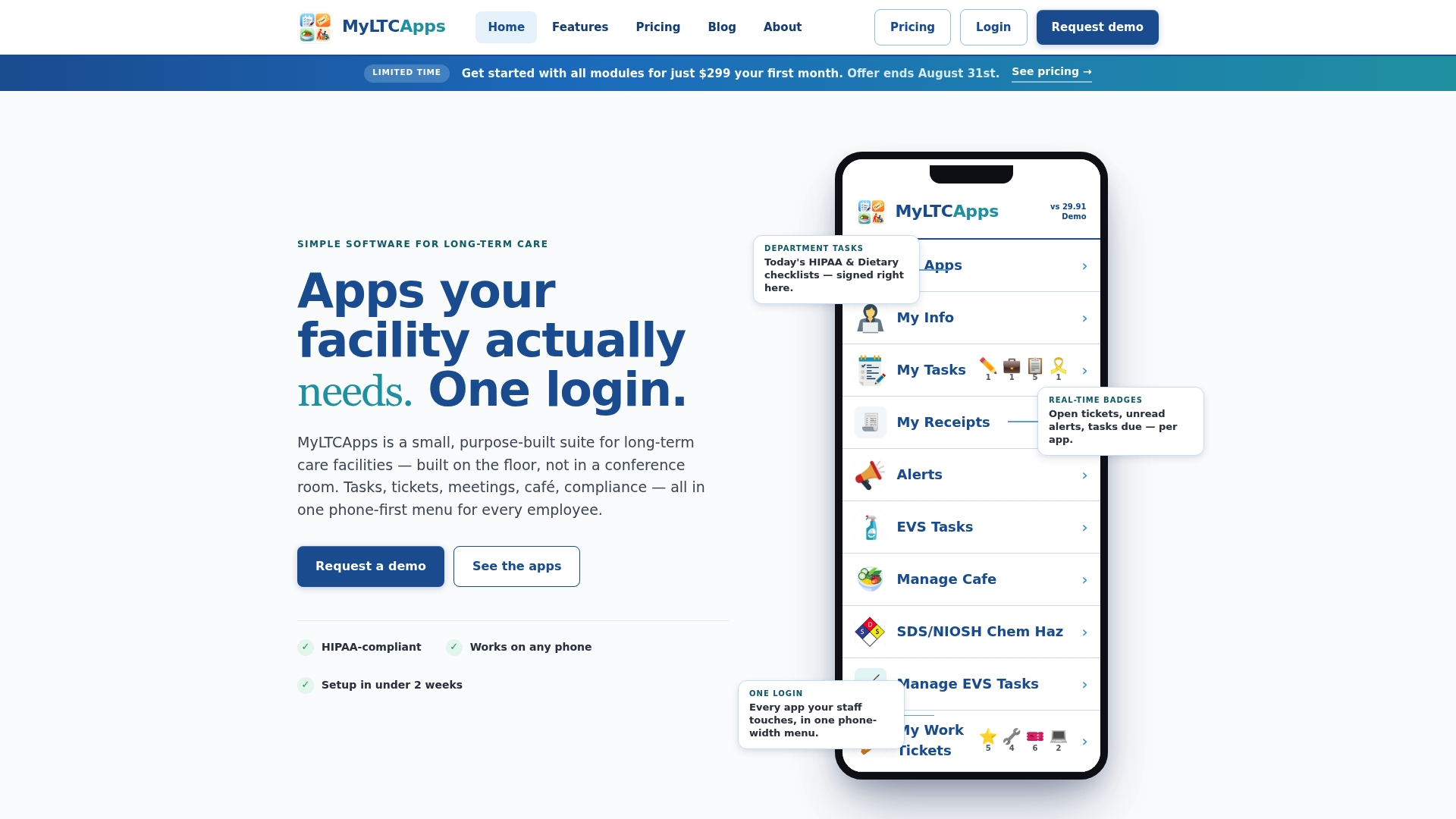
MyLTCApps’ work order and maintenance ticket software turns an equipment alert into an assigned task with a timestamp and a named staff member, so downtime doesn’t sit unassigned in a shared inbox. Pair that with mobile-first task lists that caregivers manage from their own phones, competency tracking to confirm staff are trained on new equipment protocols, and meeting and in-service attendance logs that document the training your surveyors will ask about. Every module exports audit-ready records built with long-term care compliance in mind, including HIPAA-conscious data handling.
If your facility is scoping a pilot and needs the maintenance and accountability layer to go with it, request a demo of MyLTCApps and ask specifically about work-ticket integration with your asset alerts.
Frequently Asked Questions
What is asset tracking in healthcare, exactly?
It’s the use of tags, readers, and software to give hospitals and care facilities real-time or near-real-time visibility into where medical equipment is, how often it’s used, and when it needs maintenance, replacing manual searches and spreadsheet logs.
How much time does asset tracking actually save?
Documented results vary by deployment, but the NHS pilot recovered around 30 minutes per staff member per day, and a radiology deployment cut scheduling time from 12 minutes to 5.
Is RFID or BLE better for a nursing home or hospital?
BLE tends to fit facilities that want to reuse existing Wi-Fi infrastructure and only need room- or zone-level accuracy. Active RFID delivers similar accuracy but at higher tag cost, and passive RFID works best for checkpoint tracking rather than continuous location.
Do we need a full RTLS system to start, or can we pilot smaller?
Start smaller. A single unit or one asset category, tracked with a lower-cost technology tier, gives you real data on search time and utilization before you commit to campus-wide infrastructure.
How does asset tracking help with compliance and audits?
Systems that log timestamps, user IDs, and maintenance completions create a documented history that supports Joint Commission surveys and other regulatory reviews without a manual scramble beforehand.
Sources
- Evaluation of real-time location system (RTLS) application in radiology departments- an empirical study on enhancing equipment management efficiency and patient safety
- Study identifying non-technical barriers to asset management system adoption (PMC article)
- Implementing a Real Time Location Service for medical device tracking - NHS England Digital