OSHA SDS Management: A Practical Compliance Checklist

OSHA SDS Management: A Practical Compliance Checklist
To stay compliant under OSHA’s Hazard Communication Standard (29 CFR 1910.1200), every employer must do five things right now: (1) maintain a current, 16-section Safety Data Sheet for every hazardous chemical on site, (2) make those SDSs readily accessible to employees during each work shift with zero barriers, (3) operate a written hazard communication program that covers labeling, SDS location, and training, (4) track supplier SDS updates and obtain revised sheets promptly, and (5) retain exposure records per 29 CFR 1910.1020, which means keeping SDSs or equivalent records for up to 30 years when employee exposure is documented.
Start this week:
- Audit your chemical inventory and confirm you have a current SDS for every item on the list.
- Physically test SDS access from the floor, not just from your office.
- Date-stamp any SDSs received in the last 90 days and compare them to the versions you currently have posted.
- Confirm your written hazard communication program names the SDS location, the responsible person, and the training schedule.
- Pull your retention archive and verify discontinued chemicals have a last-use date recorded.
Pro Tip: If your electronic SDS system goes down, employees still need immediate access. Keep a printed backup binder or a locally cached device at each work area as a fallback. OSHA evaluates accessibility as a performance standard, not a technology standard.
Key Takeaways
Effective OSHA SDS management requires immediate access, documented version control, and training evidence that holds up during an inspection.
| Point | Details |
|---|---|
| Maintain current 16-section SDSs | Every hazardous chemical on site needs a current SDS following the Appendix D format. |
| Accessibility is a performance standard | Workers must reach any SDS during their shift without barriers; test this from the floor, not your office. |
| Update and retain with dates | Suppliers must revise SDSs within three months of new hazard info; retain superseded versions for up to 30 years under 1910.1020. |
| Train on access and changes | Train at initial assignment and whenever a new hazard is introduced; keep signed records as audit evidence. |
| Myltcapps for LTC facilities | Myltcapps’s mobile-first SDS module provides offline access, version stamping, and exportable audit logs mapped to OSHA requirements. |
Primary sources for OSHA SDS compliance
Use these sources when reviewing regulatory text, preparing for an inspection, or updating your written hazard communication program.
- 29 CFR 1910.1200 (OSHA HCS) — The full rule text covering employer duties, SDS requirements, labeling, and training obligations.
- Appendix D to 1910.1200 — The mandatory 16-section SDS format; use this to verify that any SDS you receive is compliant.
- Federal Register, January 15, 2026 — The notice extending HCS compliance dates by four months and explaining the tiered schedule.
- OSHA HCS Q&As (2026) — Practical guidance on Appendix D updates, GHS Rev. 7 alignment, and the full compliance date table.
- 29 CFR 1910.1020 — Retention rules for employee exposure records; explains the 30-year requirement and how SDSs satisfy it.
- EPA EPCRA SDS resubmittal guidance — Relevant if your facility reports under community right-to-know laws and needs to resubmit revised SDSs.
- OSHA electronic access interpretation (1996) — The foundational interpretation confirming that electronic SDS systems are permitted when they do not create barriers to access.
During an inspection, pull these sources to show an inspector the regulatory basis for your program decisions. Citing the specific paragraph (e.g., 1910.1200(g)(8) for accessibility, 1910.1020 for retention) demonstrates that your program is built on the standard, not on a third-party template.
Table of Contents
- What does OSHA require for SDS content and format?
- What are your employer responsibilities under the HCS?
- How should you handle electronic SDS access under OSHA?
- How do you handle SDS updates and long-term retention?
- What training does OSHA require for SDS programs?
- Your OSHA-compliant SDS management checklist
- How does a mobile-first SDS system map to OSHA requirements?
- Myltcapps makes SDS compliance manageable for long-term care facilities
- Sources
What does OSHA require for SDS content and format?
OSHA’s Appendix D to 1910.1200 mandates the 16-section SDS format for all hazardous chemicals. Every compliant SDS must follow this structure exactly, and employers should know which sections they will reach for first in an emergency versus which ones matter most for routine compliance.
| SDS Section | Title | Primary Employer Use |
|---|---|---|
| 1 | Identification | Confirm chemical identity and supplier contact |
| 2 | Hazard Identification | Immediate response: know the danger class |
| 3 | Composition / Ingredients | Exposure assessment, ingredient disclosure |
| 4 | First-Aid Measures | Emergency response at point of incident |
| 5 | Fire-Fighting Measures | Incident response, evacuation planning |
| 6 | Accidental Release Measures | Spill response procedures |
| 7 | Handling and Storage | Operational controls, storage segregation |
| 8 | Exposure Controls / PPE | PPE selection, engineering controls, PELs |
| 9 | Physical and Chemical Properties | Flammability, reactivity screening |
| 10 | Stability and Reactivity | Incompatibility and decomposition risks |
| 16 | Toxicological Information | Health hazard assessment |
| 12–15 | Regulatory / Environmental | SARA, RCRA, transport flags |
| 16 | Other Information | Revision date, SDS version number |
Section 8 and Section 2 are the two sections OSHA inspectors most commonly check during a walk-through. Section 16 matters for version control: the revision date there is your evidence that the SDS is current.
Statistic callout: Under 29 CFR 1910.1200, manufacturers and importers must add significant new hazard information to an SDS within three months of becoming aware of it, and distributors must provide the updated SDS with the first shipment after that update. Employers who receive a revised SDS are expected to update their workplace program accordingly.
The OSHA HCS Q&As (2026) document clarifies that the current HCS aligns Appendix D with GHS Revision 7 and sets a tiered compliance schedule. Key dates: May 19, 2026 (initial substances compliance); November 20, 2026; November 19, 2027; May 19, 2028. The Federal Register notice from January 15, 2026 extended earlier deadlines by four months to give the regulated community time to prepare after agency guidance was published. If your SDSs or labels were last updated before 2024, they may not reflect GHS Rev. 7 changes.
What are your employer responsibilities under the HCS?
Employers are not passive recipients of SDSs. The standard places active duties on you, separate from what manufacturers and distributors must do.
Written hazard communication program checklist:
- A written program that identifies who is responsible for the SDS program and where SDSs are kept.
- A complete chemical inventory listing every hazardous chemical in use.
- A labeling system for in-house containers that matches GHS requirements.
- A documented SDS location (physical binder, electronic system, or both) named in the written program.
- A training plan covering initial assignment and any time a new hazard is introduced.
- A contractor and multi-employer coordination procedure that describes how you share SDS information with outside workers on your site.
Operational SDS record procedures:
- Assign one person (or role) as the SDS program owner. That person receives all incoming SDSs and is responsible for version control.
- Index SDSs alphabetically or by work area, whichever lets workers find a sheet fastest.
- Date-stamp every SDS when it arrives. Record the version number from Section 16.
- When a chemical is discontinued, record the last-use date on the SDS file the same day the product leaves service.
- For multi-employer worksites, document in writing which contractor is responsible for providing SDSs for the chemicals they bring on site, and confirm receipt in your log.
What counts as a barrier to access? OSHA treats “readily accessible” as a performance standard. Requiring an employee to ask a supervisor for the SDS binder key is a barrier. Requiring a password that only one person knows is a barrier. A locked cabinet with no posted combination is a barrier. The test is simple: can a worker on the floor get to the SDS during their shift without waiting for someone else’s permission?
For healthcare settings such as dental offices, OSHA SDS obligations apply with the same force. The OSHA requirements for dental offices parallel the general industry standard, with the same 16-section format and accessibility rules.

How should you handle electronic SDS access under OSHA?
OSHA permits electronic SDS management, but the 1996 interpretation on electronic access makes the condition clear: the system must not create barriers to immediate access during each work shift. That means the technology is allowed; the compliance risk lives in how you implement it.
Best practices for electronic SDS access:
- Test access from the actual work area, not from an office computer. Walk to the floor and try to pull up an SDS the way a worker would.
- Train every employee on the specific access method: which device, which app or URL, and what to do if the system is unavailable.
- Maintain an offline or printed backup at each work area. A locally cached device or a printed binder covering the chemicals used in that zone satisfies the backup requirement.
- Assign a named owner for the electronic system who is responsible for keeping it current, testing it monthly, and logging any outages.
- Keep an audit log showing when SDSs were accessed, updated, or replaced. That log is your evidence during an inspection.
- Version-stamp every SDS in the system with the date received and the Section 16 revision date.
Mobile-first workflow example: A housekeeper in a long-term care facility needs the SDS for a floor cleaner before starting a spill response. With a mobile-first system, she opens the app on her personal phone, searches by product name, and has Section 4 (first-aid) and Section 8 (PPE) on screen in under 30 seconds. No supervisor call, no binder hunt. If the Wi-Fi is down, the app’s offline cache serves the same SDS from local storage.
Three quick auditor tests for electronic SDS access:
- Ask a randomly selected worker to pull up the SDS for a chemical they use regularly. Time it. If it takes more than two minutes or requires help, that is a compliance gap.
- Disable the network connection and repeat the test. If access fails completely, you have no compliant backup.
- Check the audit log for the last 30 days. If there are no access records, either workers are not using the system or the log is not functioning.
Pro Tip: For facilities with limited IT infrastructure, a locally cached tablet mounted near the chemical storage area can satisfy both the electronic access and backup requirements simultaneously. It does not need to be connected to the internet 24/7 as long as the SDS library is synced regularly.
How do you handle SDS updates and long-term retention?
SDS updates are where most programs quietly fall out of compliance. A supplier revises a sheet, ships it with the next order, and the old version stays posted on the wall for another year.
Supplier and employer timelines:
- Manufacturers and importers must add significant new hazard information to an SDS within three months of becoming aware of it.
- Distributors must provide the updated SDS with the first shipment after the update is made.
- Employers should request updated SDSs whenever a supplier notifies them of a revision, and should not wait for the next shipment.
When you receive an updated SDS:
- Compare the new SDS to the current version. Look at Section 2 (hazard identification), Section 8 (exposure controls), and Section 16 (revision date).
- If the hazard information changed, trigger a training update for affected workers before the new chemical is used.
- Date-stamp the new SDS with the date received and file it as the current version.
- Retain the previous version with a notation of the dates it was in use. If the supplier’s formula changed, keep both versions tied to their respective exposure periods.
- Update your written hazard communication program if the chemical’s hazard category changed.
Retention under 29 CFR 1910.1020: Under the access to employee exposure and medical records standard, employers must preserve employee exposure records for 30 years. SDSs serve as acceptable exposure records when they document the hazardous materials employees worked with and the periods of exposure. The practical record must capture: the chemical identity, where it was used, and when it was used. When you discontinue a chemical, record the last-use date immediately. If the formula did not change between SDS versions, the current SDS can cover the full exposure period. If the formula changed, retain both versions with their respective date ranges.
The EPA’s EPCRA guidance also notes that facilities reporting under community right-to-know laws may need to resubmit revised SDSs to local emergency planning committees when OSHA HCS changes trigger supplier updates. If your facility handles EPCRA-reportable quantities, build that resubmission step into your SDS update workflow.
Typical update event flow:
- Supplier becomes aware of new hazard information.
- Supplier updates SDS within three months; distributor ships updated SDS with next order.
- Employer receives updated SDS, compares versions, date-stamps, and files.
- If hazard information changed: update training, labels, and written program within a reasonable period.
- Archive superseded SDS with date range of use; retain for 30 years if it documents employee exposure.
What training does OSHA require for SDS programs?
Training is not a one-time event. OSHA requires initial training before an employee works with or near a hazardous chemical, and additional training whenever a new hazard is introduced to the workplace.
Training must cover:
- The employer’s hazard communication program: where it is kept and who is responsible.
- How to read a GHS label and what each element (signal word, pictogram, hazard statement, precautionary statement) means.
- How to locate and read an SDS, including which sections to go to first in an emergency.
- The specific chemicals present in the employee’s work area and their hazards.
- How to access the SDS system (electronic or physical) during a shift.
Practical training checklist:
- Deliver a short micro-training module (10–15 minutes) at initial assignment covering SDS format and access method.
- Issue a quick-reference card keyed to SDS section numbers: Section 4 for first-aid, Section 8 for PPE, Section 2 for hazard class.
- Run a hands-on access drill: have each worker pull up or locate an SDS for a chemical they use. Document who completed it and when.
- When SDS format or hazard categories change (as with GHS Rev. 7 alignment), run a short competency check focused on the changed elements.
- Keep signed training records. During an OSHA inspection, the question is not whether you trained workers but whether you can prove it.
Pro Tip: Use SDS section numbers as the language of toolbox talks. Instead of saying “check the safety sheet,” say “look at Section 4 for what to do if it splashes on skin.” Workers remember numbered sections faster than they remember to read the whole document, and it makes retrieval feel concrete rather than optional.
Your OSHA-compliant SDS management checklist
Use this checklist to verify your program is complete. Assign an owner and a review frequency to each item.
Core program elements:
- Chemical inventory — Complete list of all hazardous chemicals on site. Owner: safety manager. Review: quarterly or when new chemicals are added.
- Current SDSs on file — One current 16-section SDS for every chemical on the inventory. Owner: safety manager. Evidence: dated SDS file with version number from Section 16.
- SDS location documented — Written program names the exact location (binder location, system URL, or both). Owner: safety manager. Evidence: written hazard communication program.
- Access test completed — Floor-level access test performed and documented. Owner: safety manager. Frequency: at least annually, and after any system change.
- Backup access in place — Printed binder or offline cache available at each work area. Owner: facilities or IT. Evidence: physical binder or device log.
- Training records current — Signed records for initial training and any hazard-change training. Owner: HR or safety manager. Evidence: sign-in sheets or digital training log.
- Retention archive active — Superseded SDSs filed with date range of use; discontinued chemicals have last-use date recorded. Owner: safety manager. Frequency: update on every SDS change or chemical discontinuation.
- Supplier update process — Procedure for requesting and receiving updated SDSs; incoming SDSs compared to current versions. Owner: purchasing or safety manager. Frequency: on every delivery from a supplier who has issued a revision.
- Multi-employer coordination — Written agreement or log showing which contractor provides SDSs for chemicals they bring on site. Owner: safety manager. Evidence: contractor coordination log.
- Written program reviewed — Full written hazard communication program reviewed and updated at least annually. Owner: safety manager. Evidence: dated revision history on the program document.
Quick-documentation templates to maintain:
- SDS version log (chemical name, SDS date received, Section 16 revision date, previous version date, reason for update).
- Last-use date field for discontinued chemicals (chemical name, last-use date, archive location).
- Training sign-off sheet (employee name, date, chemicals covered, trainer signature).
How does a mobile-first SDS system map to OSHA requirements?
Every OSHA requirement in the SDS program has a corresponding operational feature that a digital system either satisfies or fails to satisfy. The table below maps the regulatory requirement to the feature that addresses it.
| OSHA Requirement | Feature That Satisfies It |
|---|---|
| Readily accessible during each shift | Mobile access on personal or facility devices |
| No barriers to immediate access | Offline caching for network outages |
| Version control / current SDS | Version stamping with Section 16 date |
| Audit evidence | Access logs and update history |
| Training documentation | Digital sign-off and training records |
| Retention / archiving | Superseded SDS archive with date ranges |
| Role-based access | Permissions by job role or work area |
| Inspector-ready records | Exportable reports in standard formats |
Must-have features for any SDS management tool:
- Mobile access on devices workers actually carry or can reach on the floor.
- Offline caching so the SDS library is available during network outages.
- Version stamping that records the date each SDS was received and the Section 16 revision date.
- An audit log showing who accessed or updated each SDS and when.
- Exportable records that an inspector can review without needing system access.
- Role-based permissions so the right people can update SDSs and the right people can only read them.
Nice-to-have features:
- Scheduled training reminders tied to chemical inventory changes.
- Automated alerts when a supplier SDS update is detected.
- Integration with work order or incident reporting modules so chemical safety events are linked to the SDS used at the time.
Evaluation criteria: Before selecting any digital SDS tool, test it against the three auditor checks listed earlier in this article. If a worker cannot pull up an SDS in under two minutes from the floor, the system fails the accessibility standard regardless of its other features.
Pro Tip: Ask any vendor to demonstrate offline access before you sign a contract. Many platforms advertise mobile access but serve SDSs only from the cloud. If the network drops, so does your compliance.
Myltcapps’s digital SDS management module is built specifically for long-term care and skilled nursing facilities, where workers are moving between rooms and rarely at a desktop. The platform stores SDSs with version history, supports offline access, and generates exportable audit logs. For facilities with limited IT staff, the rural LTC compliance guide on the Myltcapps site walks through how to deploy mobile compliance tools without an in-house IT department.

The case for prioritizing access over perfect organization
Most SDS programs fail inspections not because the SDSs are wrong but because workers cannot get to them fast enough. A perfectly indexed binder locked in a supervisor’s office is less compliant than a slightly disorganized binder sitting open on the break room counter. OSHA’s standard is a performance standard, and the performance it measures is speed of access, not elegance of filing.
Three pitfalls I see repeatedly:
- Overreliance on a single IT system with no offline backup. When the network goes down, so does access. The fix is a locally cached device or a printed backup at each work area, not a better network.
- Skipping version stamps. An SDS without a received date is useless during a retention audit. You cannot prove what version was in use during a specific exposure period without a date on the file.
- Ignoring multi-employer SDS sharing. Contractors bring chemicals onto your site. If they do not provide SDSs and you do not ask, you are the one with the compliance gap.
Immediate next steps:
- Run the floor-level access test today. Time it. Fix what you find.
- Date-stamp every SDS in your current system that lacks a received date.
- Contact your top five chemical suppliers and ask whether they have issued any SDS revisions in the last 12 months.
- Schedule a 15-minute toolbox talk on SDS access for the next shift.
- Confirm your written program names a specific person as the SDS program owner.
Myltcapps makes SDS compliance manageable for long-term care facilities
Long-term care facilities carry a heavier SDS burden than most employers realize: cleaning chemicals, disinfectants, laundry products, and maintenance supplies all require current SDSs, accessible to staff who are moving between rooms and rarely near a computer.
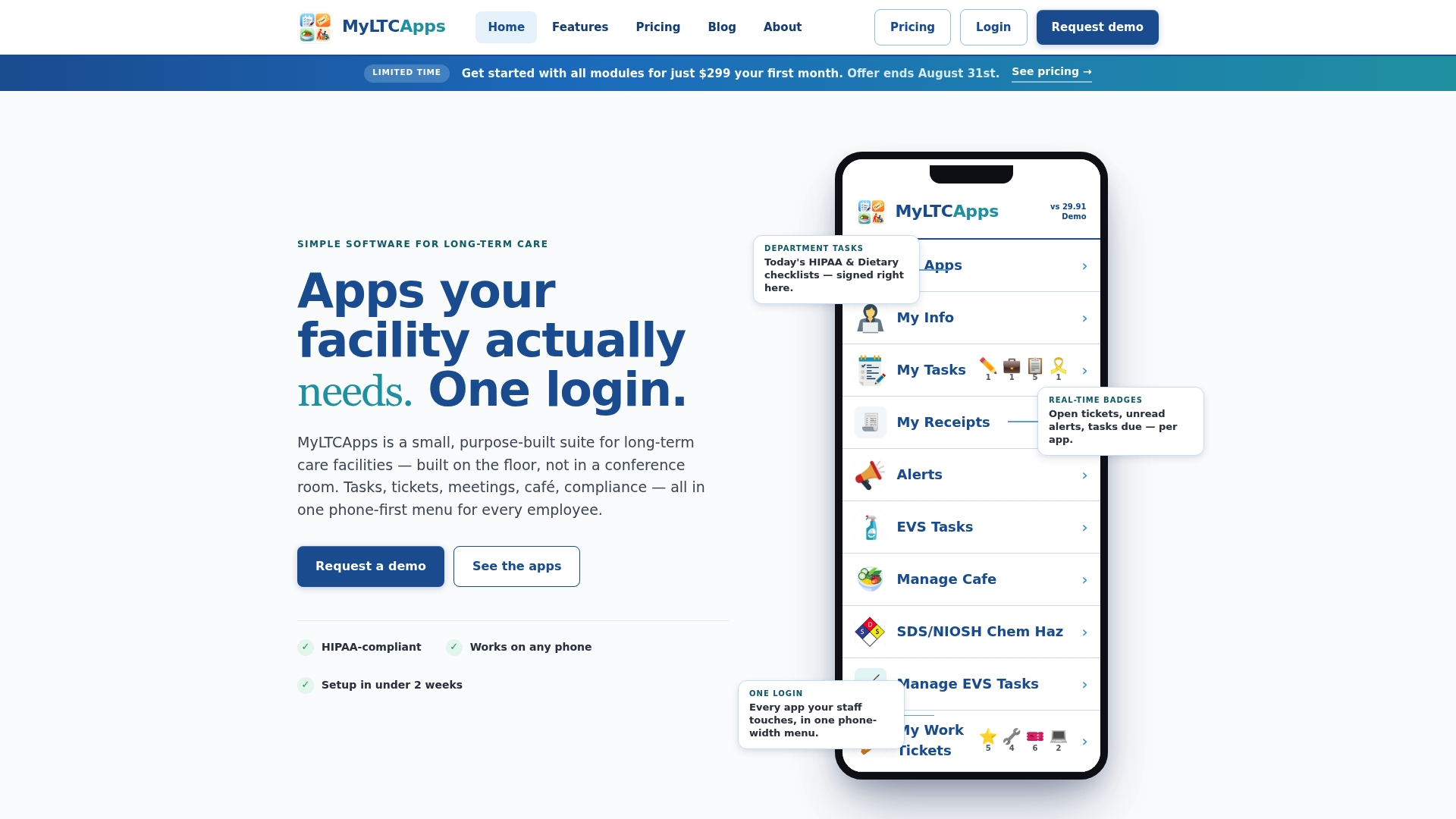
Myltcapps’s SDS management module puts every SDS on the phones your staff already carry, with offline caching so access does not depend on your Wi-Fi holding up. Version history and audit logs are built in, so when a surveyor asks to see your SDS records, you export them in minutes rather than hunting through binders. The compliance task and checklist module lets you schedule recurring SDS access tests, training sign-offs, and supplier update checks as assigned tasks with completion tracking. Staff can log training attendance digitally through the meeting and in-service tracking module, giving you the signed records OSHA expects without a paper chase. To see how Myltcapps fits your facility’s specific setup, request a quote at Myltcapps.
This article is general information, not a substitute for advice from a qualified lawyer. Consult a qualified legal professional about your own circumstances before acting on anything here.
Sources
- 1910.1200 - Hazard Communication. | Occupational Safety and Health Administration
- 1910.1200 App D - Safety Data Sheets (Mandatory)
- Federal Register: Hazard Communication Standard final rule (compliance date extensions)
- OSHA HCS Q-and-As (2026)
- OSHA interpretation: electronic access and accessibility of MSDS/SDS (1996)