What an Audit Trail in Healthcare Actually Proves

What an Audit Trail in Healthcare Actually Proves
An audit trail in healthcare is a time-stamped record of every user interaction with electronic protected health information (ePHI), including who accessed it, what they changed, and when. It exists for one blunt reason: when something goes wrong, whether that’s a HIPAA complaint, a ransomware event, or a malpractice claim, the audit trail is the only witness that doesn’t forget, lie, or get deposed with a shaky memory.
Three entities anchor everything that follows. The HIPAA Security Rule at 45 CFR §164.312(b) requires audit controls as a technical safeguard. The HHS Office for Civil Rights (OCR) audit program uses a published protocol to check whether you’ve actually built them. And operational platforms like Myltcapps generate a parallel evidence layer that captures the day-to-day work happening outside the EHR.
Here’s why administrators can’t treat this as a checkbox:
- Regulators expect audit controls as a baseline safeguard, not an optional add-on.
- Security teams rely on logs to catch insider snooping and mass data exports before they become breaches.
- Litigators and courts increasingly request raw audit trails as primary evidence in malpractice and wrongful-death cases.
Key Takeaways
A defensible healthcare audit trail requires immutable storage, complete metadata fields, documented reviews, and a preservation process ready before litigation ever starts.
| Point | Details |
|---|---|
| Capture the right fields | Log user ID, role, patient identifier, action type, timestamp, device ID, and before/after values on every edit. |
| Lock down immutability | Use WORM or equivalent storage so logs can’t be altered after the fact, protecting their evidentiary value. |
| Review on a real cadence | Automate alerts for mass exports and after-hours access, then document monthly audits and remediation. |
| Preserve before you’re asked | Trigger a legal hold and request narrow, specific metadata fields the moment litigation becomes plausible. |
| Add an operational layer | Myltcapps timestamps task completion, meeting sign-ins, and competency checks to complement EHR audit logs during surveys and investigations. |
Table of Contents
- What Is an Audit Trail Used for in Healthcare?
- What Data Fields Belong in a Defensible Audit Trail?
- What Do HIPAA and Related Standards Require?
- How Should You Build Audit Trail Infrastructure?
- Who Should Review Audit Trails and How Often?
- How Do You Preserve and Produce Audit Trails for Litigation?
- Where Does Operational Logging Fit Alongside the EHR?
- What Priorities Actually Move the Needle First?
- How Myltcapps Supports Your Compliance Documentation
- Frequently Asked Questions
- Sources
What Is an Audit Trail Used for in Healthcare?
Audit trails do four jobs at once, and most facilities only think about one of them until an incident forces the other three into view.
- Security detection. A well-built log flags unusual patterns automatically: a nurse aide pulling up a chart at 3 a.m. with no shift assigned, a single user exporting hundreds of records in a burst, or a login from a device that’s never touched the network before.
- Compliance demonstration. When OCR asks how you enforce “minimum necessary” access, your answer isn’t a policy document. It’s a log showing that access matched job role, every time.
- Medico-legal evidence. Audit trails reconstruct exactly what happened and when, which matters enormously when a chart entry looks like it was added after the fact. Courts have sanctioned hospitals for failing to produce these logs, and plaintiffs’ attorneys now routinely request them to check for back-dated entries and ignored clinical alerts.
- Operational quality assurance. Surveyors want proof that your staff actually completed the tasks your policy says they do, and a clean log trail answers that faster than a binder of signed paper forms.
What Data Fields Belong in a Defensible Audit Trail?
A log that just says “John accessed a record” is worthless in an investigation. Defensible audit trails capture specific, granular fields that let an investigator reconstruct the full sequence of events without guessing.
At minimum, every entry needs:
- User ID and role (not just a name, but the job function tied to that access)
- Patient identifier linked to the record touched
- Action type (view, edit, print, export, delete)
- Exact timestamp, synced to a single authoritative clock across systems
- Workstation or device identifier, including IP address where available
- Success/failure flag for login and access attempts
Edits need even more. A defensible system captures before and after values for any change, not just the fact that a change occurred, along with a sequence ID that shows where that edit falls relative to other events. Some systems add cryptographic hashes or append-only markers so nobody can quietly rewrite history later.
Pro Tip: Time synchronization sounds boring until an attorney asks why your EHR timestamp and your medication dispensing cabinet timestamp are four minutes apart. Sync every logging system to the same network time source, or your “exact” timestamps become an argument, not evidence.
Both system-level logs (server, network, identity provider) and application-level logs (the EHR itself) matter here. Application logs show what a user did inside the chart. System logs show whether that user’s credentials were even legitimate at the time. Investigators who only pull one layer routinely miss the other half of the story.
What Do HIPAA and Related Standards Require?
The regulatory floor is lower than most administrators assume, and that’s exactly why the practical bar needs to be higher.
- 45 CFR §164.312(b) requires “hardware, software, and/or procedural mechanisms that record and examine activity” in any system housing ePHI. It doesn’t specify exact fields or retention periods, which is why so many facilities under-build this control.
- 45 CFR §164.308 adds the administrative side: regular review of those records, not just their existence.
- The OCR HIPAA Audit Program uses a detailed protocol to assess covered entities against these provisions, and recent audit cycles have leaned harder on ransomware and hacking-related Security Rule provisions, meaning your access logs and incident detection capability now get scrutinized as closely as your privacy policy.
- ONC certification criteria under Meaningful Use required certified EHR technology to include audit log functionality as a baseline feature, which is part of why virtually every modern EHR has some logging built in already.
- ASTM E2147-18 provides an industry standard for what a health data audit trail should record, giving vendors and auditors a shared technical reference point beyond the regulatory text.
The audit control requirement doesn’t tell you how long to keep logs or how often to review them. It tells you that you must be able to answer, credibly, who touched this record and when. Everything else is professional judgment.
Retention deserves its own line item. Keeping the raw logs is only half the job. AHIMA guidance.pdf) recommends retaining documented proof that reviews actually happened, separate from the raw data itself, often for six years to align with HIPAA’s general documentation retention standard.
How Should You Build Audit Trail Infrastructure?
Good architecture treats logging as its own system, not an afterthought bolted onto the EHR.
- Instrument every touchpoint. EHR, eMAR, identity provider (single sign-on), workstations, and networked devices all need to feed the same logging pipeline. Facilities that log only the EHR miss the login layer that proves whether access was even authorized.
- Keep raw events untouched. Preserve the original log format alongside any normalized copy you build for reporting. Investigators and courts trust raw formats far more than a dashboard summary.
- Lock storage down. Write-once-read-many (WORM) storage, or an equivalent immutable configuration, prevents anyone (including a well-meaning IT admin) from editing history after the fact. Encrypt logs at rest and keep them on infrastructure separate from the systems generating them.
- Centralize the feed. Routing logs into a SIEM or dedicated repository cuts investigation time dramatically and helps meet OCR’s expectation of timely breach detection, rather than discovering an exposure six months later during an unrelated review.
- Map users to roles consistently. A username alone tells you nothing about whether that access was appropriate; role mapping is what turns a raw log into an auditable one.
- Tier your retention. Hot storage for the last 90 days of fast-access data, warm storage for the past year, and cold archival storage beyond that keeps costs manageable without sacrificing defensibility.
Pro Tip: If you’re exporting a raw log for a legal hold, capture a hashed, signed copy of that export along with a short declaration naming the IT staff member who ran the extraction and the exact query used. That single document has saved facilities from spoliation arguments more than once.
Who Should Review Audit Trails and How Often?
Ownership matters more than tooling here. A perfect logging system reviewed by nobody is functionally the same as no logging system.
Assign responsibility clearly: security or IT staff own technical monitoring, the privacy officer owns compliance-facing review, unit leads flag anomalies in their own departments, and HR gets looped in the moment a pattern points to a workforce issue rather than a system glitch.
Automate alerts for the events that can’t wait for a scheduled review:
- Privileged or administrator-level access to patient charts
- Bulk or mass record exports
- Bursts of failed login attempts
- “Break-glass” emergency access overrides
Beyond automated alerts, build a cadence: near real-time triage for critical alerts, weekly trend review for access patterns, a full monthly audit cycle, and quarterly tests of your detection and response process. Document every review, including what was checked, what was found, and what remediation followed. That documentation, not the raw logs alone, is what proves to a surveyor or auditor that oversight is real rather than theoretical.
How Do You Preserve and Produce Audit Trails for Litigation?
The moment a serious incident, complaint, or lawsuit becomes plausible, your obligations shift from “review periodically” to “preserve immediately.”
- Trigger a legal hold the moment litigation is reasonably anticipated. This suspends any routine purge schedule that would otherwise overwrite the exact records you need.
- Request specifically, not broadly. Ask for the exact time window, the metadata fields involved (user ID, role, timestamp, workstation, action type, before/after values), the categories of users with access, and native formats like CSV rather than a PDF screenshot.
- Anticipate the defense playbook. Facilities often argue that audit trails fall outside the “designated record set” or that a request is disproportionate. Precise, narrow requests undercut both objections far more effectively than a broad demand for “all logs.”
- Document chain of custody. A short IT declaration describing how the export was generated, by whom, and when turns a spreadsheet into admissible evidence.
Courts have sanctioned hospitals for failing to produce audit trails, and plaintiffs’ counsel increasingly know exactly which metadata fields to ask for. Vague requests get vague objections. Specific requests get specific answers.
Where Does Operational Logging Fit Alongside the EHR?
EHR audit trails cover clinical charting. They don’t capture whether the housekeeping checklist got completed, whether a nurse aide signed into a required in-service, or whether a competency assessment happened on schedule. That gap matters more than most compliance officers realize until a survey or investigation asks about it directly.
Myltcapps builds that second evidence layer without touching clinical charting at all. Its logs support, rather than replace, your EHR’s audit trail:
- Compliance task and checklist completion timestamps show exactly when a required task was finished and by whom.
- Meeting sign-in and in-service tracking creates a time-stamped record of staff training attendance, useful when a surveyor questions whether required education actually happened.
- Nurse competency tracking logs when skills assessments were completed, which becomes relevant evidence in a corrective-action or negligent-supervision inquiry.
During an investigation, mapping these operational timestamps against your EHR’s clinical audit log can fill in the “what was staff doing” context that clinical records alone don’t show.
What Priorities Actually Move the Needle First?
If I had to rank where facilities should spend their first dollar, immutability and provenance come before automation, and automation comes before retention length. A system that logs everything but lets anyone quietly edit the archive later isn’t worth much in front of a judge. Get tamper-resistant storage and clean before/after capture working first.

Smaller facilities with tight budgets shouldn’t try to build the full SIEM-and-six-year-archive setup on day one. Stage it: lock down immutability, then add centralized alerting, then extend retention tiers as budget allows. A partial system built in the right order beats a comprehensive one that never gets finished.
How Myltcapps Supports Your Compliance Documentation
The audit trail work above covers your EHR. But surveyors, auditors, and opposing counsel don’t stop at clinical records. They also ask whether your staff actually did the checklist, attended the training, or completed the competency review they were assigned. Myltcapps is built for exactly that gap: a phone-first system where every completed task, signed-in meeting, and finished checklist generates a time-stamped record automatically, instead of relying on paper logs that go missing right when you need them.
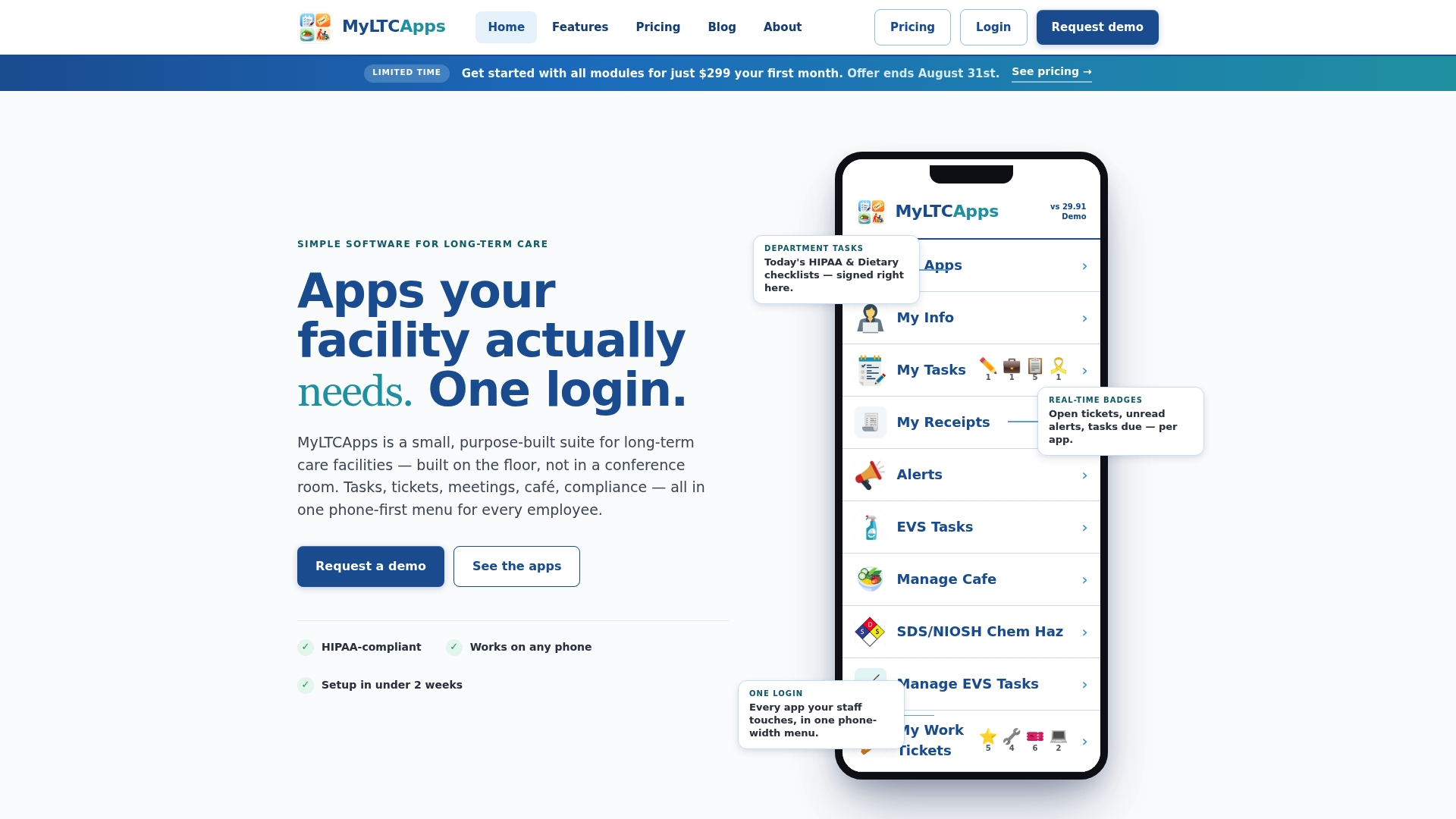
For a facility preparing for its next survey, that means pulling a clean report of completed compliance checklists instead of chasing down binders the night before an inspector arrives. For a facility responding to an incident, it means having operational timestamps ready to hand your investigator alongside the EHR audit log. Start with the compliance task and checklist software to see how your facility’s daily operational record could look with everything time-stamped and centralized from day one.
Frequently Asked Questions
What is an audit trail in healthcare? It’s a time-stamped record of every interaction with electronic protected health information, including who accessed a record, what they did, and when. It’s built specifically to be reviewed later during compliance checks, security investigations, or litigation.
How long should healthcare organizations retain audit trail data? HIPAA doesn’t set one fixed number for raw log retention, but documentation of your audit reviews should generally be retained for six years to match HIPAA’s broader documentation retention standard.
What’s the difference between an EHR audit trail and operational logging? An EHR audit trail tracks clinical chart access and edits. Operational logging, the kind Myltcapps generates, tracks whether staff completed assigned tasks, attended required training, or finished a competency check. They’re complementary, not interchangeable.
Can patients request their own audit trail? Patients can request an accounting of disclosures under HIPAA, though the scope differs from a full technical audit trail. Facilities should have a documented process for handling these requests consistently.
What triggers a legal hold on audit trail data? A legal hold should start the moment litigation, a formal complaint, or a serious incident becomes reasonably foreseeable, not after a lawsuit is formally filed. Waiting risks routine data purges destroying the exact records you’ll need.
This article is general information, not a substitute for advice from a qualified doctor. Consult a qualified healthcare professional about your own circumstances before acting on anything here.
Sources
- HIPAA Audits and the OCR audit program — HHS / OCR
- 45 CFR §164.312 — Security standards: technical safeguards (audit controls)
- EHR audit trails as litigation evidence: discovery to trial — LegalClarity