Near Miss Reporting for Safety Managers: Set Up and Act

Near Miss Reporting for Safety Managers: Set Up and Act
Near miss reporting means documenting any unplanned event that did not cause injury or damage but had the potential to do so, giving your safety program a leading indicator to act on before someone gets hurt. Two things you should do today:
- Enable a one-step reporting route. A QR code at each workstation, a mobile form, or a simple paper slip at the nurses’ station — pick one and make it reachable in under 30 seconds from any work area.
- Commit to a 24-hour acknowledgement promise. Every report gets a response within one shift. No exceptions. That single commitment, backed by OSHA guidance and reinforced by the National Safety Council (NSC) and ISO 45001, is what separates programs workers trust from ones they ignore.
Table of Contents
- What counts as a near miss? Common examples to use in training
- Why near miss reports are worth the effort
- How to set up a near miss reporting system that workers will actually use
- How to investigate a near miss and close the feedback loop
- Which metrics tell you if your near miss program is working
- U.S. legal and compliance context for near miss reporting
- What mobile-first near miss reporting looks like in a long-term care facility
- Key Takeaways
- Why trust matters more than technology when you launch near miss reporting
- Myltcapps makes near miss reporting practical for long-term care facilities
- Useful sources and templates
What counts as a near miss? Common examples to use in training
A near miss is any close call where the outcome was luck, not design. The USI/ISCC-WC workplace guide defines it as an unplanned event with the potential to cause injury or damage — which means the threshold is potential severity, not actual harm.
Use these categories in toolbox talks and shift huddles:
- Slips, trips, and falls: A wet floor near the medication cart with no wet-floor sign placed. No one fell — this time.
- Equipment malfunctions: A mechanical lift that stuttered mid-transfer during resident repositioning. The resident was not dropped, but the equipment failed.
- Procedural errors: A CNA prepared the wrong resident’s medications before catching the mistake at the bedside.
- PPE failures: A glove tore during wound care before the staff member noticed. No exposure occurred.
- Resident handling close calls: A resident began sliding from a wheelchair during transport; a second staff member caught them before impact.
- Chemical/hazardous material near misses: A cleaning solution was stored in an unlabeled container near the dining area. No one ingested it, but the potential was real.
- Environmental hazards: A frayed extension cord running across a hallway, noticed by a housekeeper before anyone tripped.
The rule of thumb: if removing the luck factor would have produced an injury, it is reportable. Severity of potential outcome matters far more than what actually happened.
Pro Tip: Print these categories on a laminated card and post it next to each reporting QR code. Staff who can see examples report more accurately and more often.
Why near miss reports are worth the effort
Near-miss reporting prevents incidents by surfacing hazards before they produce injuries. That is not a theory — a study published in the American Journal of Industrial Medicine found that implementing a near-miss reporting system was associated with a decrease in OSHA recordable injury rates in manufacturing over time. The mechanism is straightforward: every report is a free lesson about a hazard your facility already has.
Near-miss incidents can be considered a leading indicator of potential incidents, providing opportunities to improve safety and enhance productivity without experiencing an actual incident. — PMC / NIOSH case study
Industry guidance frames this plainly: correcting hazards proactively costs far less than reacting to injuries, workers’ compensation claims, and regulatory citations.
One counterintuitive point worth sharing with leadership: when a new program launches, report counts usually go up sharply. That is a good sign. The EU-OSHA OSHwiki notes that early increases in near-miss reports typically reflect improved reporting behavior, not a worsening hazard environment. Treat a rising count as evidence the culture is shifting.
Pro Tip: When presenting the program to administrators, frame the first 90 days as a “baseline collection period.” Rising numbers are proof the system is working, not proof the facility is unsafe.
How to set up a near miss reporting system that workers will actually use
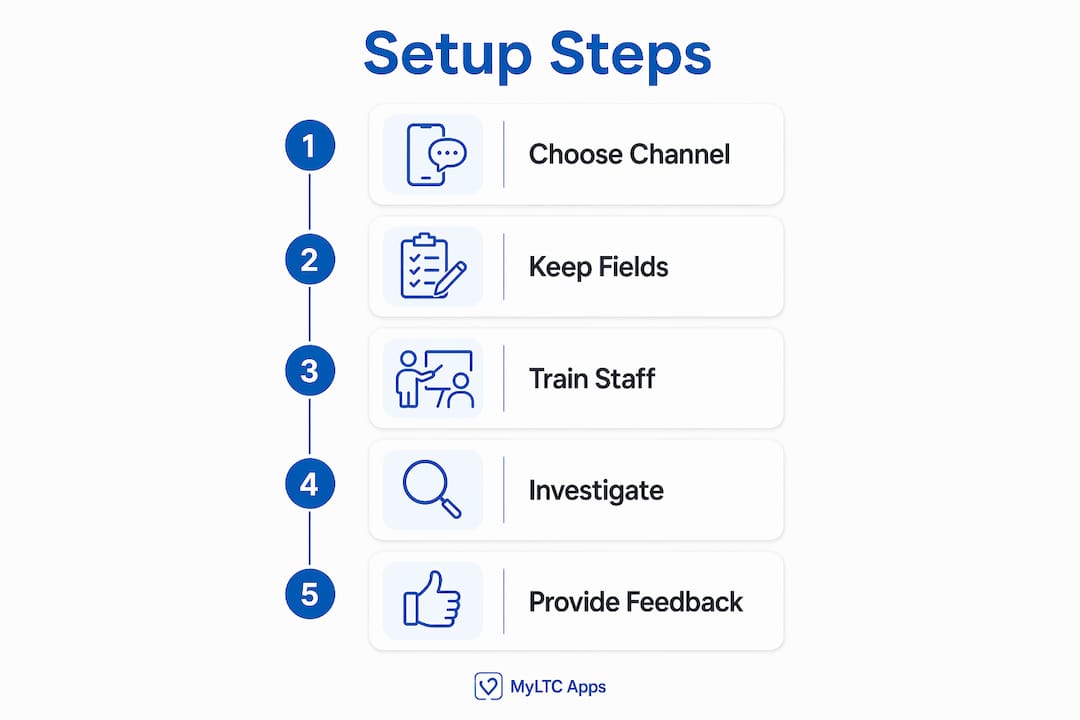
Start with the reporting channel. Pick one, make it visible, and resist the urge to build a complex multi-step process. A QR code that opens a three-field mobile form beats a 12-field paper binder that lives in the supervisor’s office.
Minimum form fields
Keep mandatory fields to three. Research supports this: too many required fields reduce front-line compliance.

| Field | Why it matters |
|---|---|
| What happened | Captures the event description for investigation |
| Where it happened | Enables location-based trend analysis |
| Hazard present | Identifies the root risk category |
| Date and time | Supports timeline reconstruction and shift correlation |
Optional fields — photos, suggested fixes, contributing factors — should be available but never required.
Policy essentials
- Non-punitive statement: Written policy that no disciplinary action results from good-faith near-miss reports.
- Anonymity option: Allow anonymous submission. The NSC recommends this explicitly as a driver of participation.
- Defined roles: Who receives reports, who triages, who investigates, and who closes.
- Response timelines: 24-hour acknowledgement; closure targets by severity tier (see triage below).
Triage workflow
| Potential severity | Who investigates | Target closure |
|---|---|---|
| Low (minor hazard, limited exposure) | Supervisor | 5 business days |
| Medium (potential for recordable injury) | Safety manager | — |
| High (potential for serious injury or fatality) | Safety manager + leadership | — |
Pro Tip: Use your in-service tracking system to document near-miss training sessions. Attendance records become audit evidence that staff were trained on what to report and how.
How to investigate a near miss and close the feedback loop
Every near miss needs acknowledgement and an investigation scaled to its potential severity. A low-potential slip on a dry floor needs a supervisor note and a corrective action. A near-miss during a resident transfer with a malfunctioning lift needs a full root-cause investigation before that equipment is used again.
Investigation steps
- Acknowledge the report within 24 hours. Confirm receipt and assign an investigator.
- Document the facts. Gather witness accounts, photos, equipment logs, and shift records while the details are fresh.
- Select investigation depth. Low-potential events: supervisor review. Medium/high-potential: structured root-cause analysis.
- Apply root-cause tools. The 5 Whys is the most accessible method for front-line supervisors. Fishbone (Ishikawa) diagrams work well for medium-complexity events involving multiple contributing factors.
- Decide corrective actions. Link each action directly to a causal pathway, not just the surface symptom.
- Assign ownership and due dates. Every action needs a named owner and a deadline.
- Close and communicate. Notify the reporter of the outcome. This step is what drives repeat reporting.
5 Whys worked example (LTC scenario)
Event: A CNA nearly administered the wrong resident’s oral medication.
- Why? The medication cups were placed on the wrong tray.
- Why? Two residents’ trays were staged side by side without name labels.
- Why? The labeling step was skipped during a busy shift.
- Why? No visual prompt exists at the staging area to require labeling.
- Why? The procedure was verbal-only and not posted at the point of care.
Corrective action: Post a laminated labeling checklist at the medication staging area and add a labeling verification step to the written procedure.
A common program failure is acting on surface fixes without root-cause analysis. This produces repeat hazards. Always document root cause and link corrective action to the causal pathway.
Action-assignment template fields
| Field | Purpose |
|---|---|
| Action description | What will be done |
| Owner (name/role) | Who is accountable |
| Due date | When it must be complete |
| Status | Open / In progress / Closed |
Use your work-ticket system to convert physical hazard corrections directly into assigned maintenance tasks with due dates and closure tracking.
Pro Tip: Send a one-sentence update to the original reporter when the corrective action closes. That message, even automated, is the single strongest driver of future reporting.
Which metrics tell you if your near miss program is working
Track both activity metrics (are people reporting?) and outcome metrics (are hazards getting fixed?). Activity alone tells you nothing about prevention; outcomes alone miss early warning signs.
| KPI | Definition | Calculation | Target guidance |
|---|---|---|---|
| Near-miss frequency rate (NMFR) | Reports per hours worked | (Reports ÷ hours worked) | Rising trend in first 6 months = healthy |
| Report-to-action ratio | Percentage of reports with documented corrective action | (Reports with action ÷ total reports) | 100% — every report gets a response |
| Time-to-close | Average days from report to corrective action closure | Sum of close days ÷ number of closed reports | Under — for medium-potential events |
| Repeat-hazard rate | Percentage of reports involving a previously identified hazard | (Repeat hazard reports ÷ total reports) | Declining trend over time |
| Distribution by location/task | Report count by unit, shift, or task type | Count by category | Identifies hotspots for targeted intervention |
A NIOSH case study analyzing valid near-miss reports found that a substantial proportion were rated high or critical risk — indicating that many near misses in an active program carry serious injury potential. That distribution alone justifies tracking by severity tier, not just total count.
Suggested review cadence: Weekly triage of new reports, monthly trend review with the safety committee, quarterly audit of corrective action closure rates.
U.S. legal and compliance context for near miss reporting
OSHA does not mandate universal near-miss reporting under 29 CFR 1904, but the agency explicitly encourages employers to investigate close calls. ISO 45001 includes near misses within its incident management framework, making a documented program a practical requirement for facilities pursuing or maintaining that certification.
Key compliance points:
- When to escalate: Any near miss with potential for serious injury or fatality should be documented and investigated with the same rigor as a recordable incident. Do not wait for an injury to trigger a formal process.
- Recordkeeping: Maintain report logs, investigation notes, corrective action assignments, and closure evidence. These records support OSHA inspections, internal audits, and accreditation surveys.
- State-level variation: Kansas facilities should consult the Kansas Department of Labor and, for long-term care, KDADS guidance for any state-specific reporting thresholds that supplement federal OSHA requirements. Requirements vary by industry and incident type.
- HIPAA in LTC: Near-miss reports involving residents must protect identifying information. Strip or de-identify resident details before circulating reports beyond the investigation team.
OSHA provides a template for near-miss reporting policy that employers can adapt, emphasizing reporting requirements and timely investigation. — OSHA Near Miss Reporting Policy Template
This article provides general information, not legal or compliance advice. Confirm current requirements with OSHA, KDADS, or a qualified safety professional for your specific facility.
What mobile-first near miss reporting looks like in a long-term care facility
A mid-size skilled nursing facility in the Midwest implemented mobile-first close-call reporting with three changes: QR codes posted at each nursing station and common area, a three-field mobile form (what, where, hazard), and a supervisor triage rule requiring acknowledgement before the end of the next shift.
The results followed a predictable pattern. Report volume rose in the first 60 days. Staff initially interpreted this as a problem; the safety manager reframed it as baseline data collection. Within 90 days, time-to-close on medium-potential reports dropped as supervisors built the triage habit. Documented corrective actions increased, and repeat-hazard reports on the same locations began declining.
Implementation checklist for LTC facilities:
- Post QR codes at nursing stations, the medication room, dining area, and maintenance hallways.
- Limit the mobile form to three mandatory fields; add a photo upload as optional.
- Set supervisor triage rules in writing: who reviews each tier, and by when.
- Integrate physical hazard reports directly with maintenance work tickets so a reported broken handrail becomes an assigned task, not a verbal note.
- Protect resident privacy by keeping identifying details out of circulated reports. Review your HIPAA compliance checklist before finalizing your report template.
Digital reporting tools reduce friction, but the human element — trust and visible follow-up — remains the dominant factor in whether staff keep reporting. Technology scales a working process; it does not fix a broken one.
Pro Tip: Have a charge nurse or director of nursing submit the first near-miss report publicly during a shift huddle. Visible leadership participation signals that reporting is valued, not punished.
Key Takeaways
Near miss reporting works when it is simple to submit, fast to acknowledge, and visibly acted upon — those three conditions drive repeat reporting more than any software feature.
| Point | Details |
|---|---|
| Start with one reporting channel | A QR code or mobile form with three mandatory fields reduces friction and increases submissions. |
| Guarantee 24-hour acknowledgement | A written commitment to respond within one shift is the single strongest trust signal for reporters. |
| Triage by potential severity | High-potential near misses need closure within —; medium-potential near misses within —. |
| Track NMFR and time-to-close | Rising report frequency in early months signals a healthy culture shift, not a worsening hazard environment. |
| Myltcapps for LTC facilities | Myltcapps provides mobile forms, work-ticket integration, and closure tracking suited to skilled nursing and long-term care workflows. |
Why trust matters more than technology when you launch near miss reporting
The hardest part of building a near-miss program is not the form or the software. It is convincing a floor nurse or a CNA that submitting a report will not result in a write-up. That trust problem is older than digital safety tools, and no app solves it on its own.
What actually moves the needle: a leader submitting a near-miss report in front of the team, in a shift huddle, about something they personally observed. Not a policy memo. Not a training video. A person with authority demonstrating that reporting is a normal, valued act. That one moment does more for program adoption than three months of email reminders.
The feedback loop is where programs live or die. Automated acknowledgements are fine for speed, but every reporter should eventually receive a substantive update: what was found, what was fixed, and when. That message closes the loop and earns the next report. Programs that skip this step see submission rates plateau or decline within six months, regardless of how good the technology is.
Align your near-miss metrics with safety goals, not blame. When a supervisor’s performance review includes “near-miss reports submitted by team,” the incentive structure shifts from concealment to transparency. That alignment is a policy decision, not a software feature.
Myltcapps makes near miss reporting practical for long-term care facilities
Long-term care facilities carry a specific burden: high staff turnover, complex resident care workflows, and regulatory scrutiny that does not pause for program rollouts. Myltcapps is built for exactly that environment.
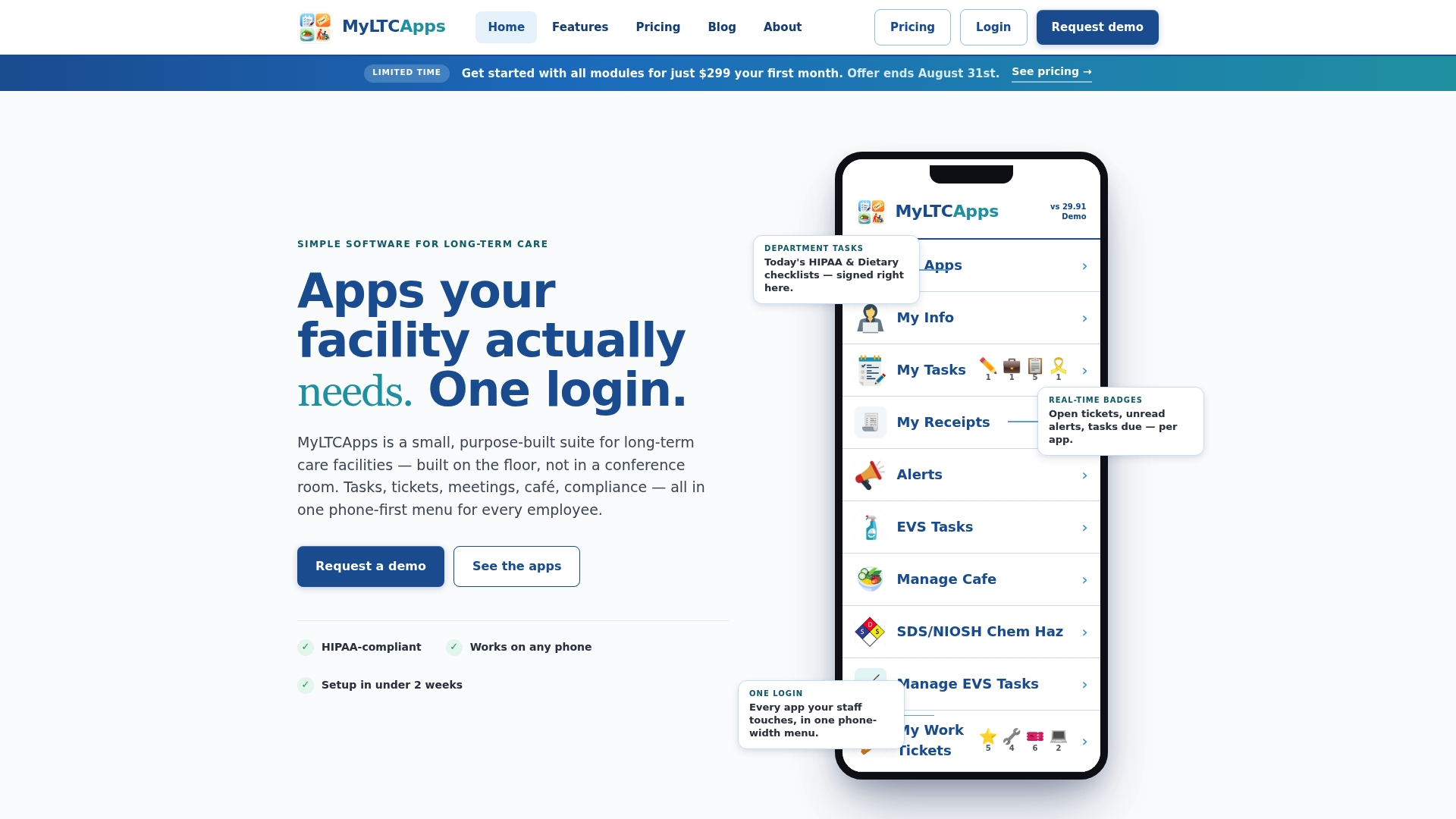
The platform’s phone-first design means a CNA can submit a close-call report in under 30 seconds from their personal device, with no login barrier and no desktop required. Reported hazards connect directly to maintenance work tickets, so a broken grab bar goes from report to assigned task without a phone call or a sticky note. Closure tracking and facility alert workflows keep supervisors and reporters in the loop automatically. For Kansas facilities, Myltcapps exports are formatted for KDADS readiness, reducing audit prep time.
The full suite covers incident reporting, compliance checklists, shift scheduling, and operational dashboards in one interface. Facilities can be live with a QR-code reporting workflow in a single day. To see how it fits your facility’s workflow, request a demo at myltcapps.com/ltpac-software.
Useful sources and templates
Authoritative resources for safety managers building or improving a near-miss reporting program:
- OSHA Near Miss Reporting Policy Template — Downloadable policy template from OSHA; adapt it directly for your facility’s written program.
- National Safety Council: Near Miss Reporting — Guidance on non-punitive culture, anonymity options, and program design principles.
- ISSA Guidance on How to Manage Near Misses — Detailed international guidance covering system design, data collection fields, triage, and feedback processes; includes sample scoring frameworks.
- USI/ISCC-WC Guide to Near-Miss Reporting in the Workplace — Practical workplace guide with definition, examples, and form field recommendations; useful for training materials.
- PMC/NIOSH Near-Miss Case Study — Peer-reviewed analysis of 167 near-miss reports with risk matrix coding and corrective action patterns; supports the business case for formal programs.
- EU-OSHA OSHwiki: Near Misses — Background on near-miss definitions, reporting culture, and how early program spikes should be interpreted.
- Myltcapps Platform Overview — Product inquiries, demo requests, and module details for LTC and skilled nursing facilities.
| Resource | Best for |
|---|---|
| OSHA Policy Template | Writing or updating your facility’s near-miss reporting policy |
| NSC Near Miss Guidance | Culture and anonymity program design |
| ISSA Management Guidance | Full system design including triage scoring |
| USI/ISCC-WC Workplace Guide | Staff training materials and form field selection |
| PMC/NIOSH Case Study | Justifying the program to leadership with research |
| Myltcapps | Mobile-first reporting and work-ticket integration for LTC |
Recommended
- Compliance Task & Daily Checklist Software for Long-Term Care | MyLTC Apps
- Rural Nursing Home Compliance Software: Closing the Gap Without an IT Department | MyLTC Apps
- Facility Alert & Communication System for Long-Term Care | MyLTC Apps
- A HIPAA Compliance Checklist for Long-Term Care Facilities | MyLTC Apps